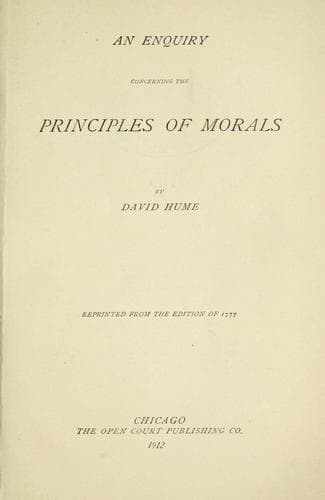
An Enquiry Concerning the Principles of MoralsHume, David
PhilosophyPhilosophy
An Enquiry Concerning the Principles of Morals
Hume, David
Conduct of life; Ethics
Even in societies, which are established on principles the most immoral,
and the most destructive to the interests of the general society, there
are required certain rules, which a species of false honour, as well as
private interest, engages the members to observe. Robbers and pirates,
it has often been remarked, could not maintain their pernicious
confederacy, did they not establish a pew distributive justice among
themselves, and recall those laws of equity, which they have violated
with the rest of mankind.
I hate a drinking companion, says the Greek proverb, who never forgets.
The follies of the last debauch should be buried in eternal oblivion, in
order to give full scope to the follies of the next.
Among nations, where an immoral gallantry, if covered with a thin veil
of mystery, is, in some degree, authorized by custom, there immediately
arise a set of rules, calculated for the conveniency of that attachment.
The famous court or parliament of love in Provence formerly decided all
difficult cases of this nature.
In societies for play, there are laws required for the conduct of the
game; and these laws are different in each game. The foundation, I own,
of such societies is frivolous; and the laws are, in a great measure,
though not altogether, capricious and arbitrary. So far is there a
material difference between them and the rules of justice, fidelity, and
loyalty. The general societies of men are absolutely requisite for the
subsistence of the species; and the public conveniency, which regulates
morals, is inviolably established in the nature of man, and of the
world, in which he lives. The comparison, therefore, in these respects,
is very imperfect. We may only learn from it the necessity of rules,
wherever men have any intercourse with each other.
They cannot even pass each other on the road without rules. Waggoners,
coachmen, and postilions have principles, by which they give the way;
and these are chiefly founded on mutual ease and convenience. Sometimes
also they are arbitrary, at least dependent on a kind of capricious
analogy like many of the reasonings of lawyers.
[Footnote: That the lighter machine yield to the heavier, and, in
machines of the same kind, that the empty yield to the loaded; this rule
is founded on convenience. That those who are going to the capital take
place of those who are coming from it; this seems to be founded on some
idea of dignity of the great city, and of the preference of the future
to the past. From like reasons, among foot-walkers, the right-hand
entitles a man to the wall, and prevents jostling, which peaceable
people find very disagreeable and inconvenient.]
Public-domain text, read in full here on John Shaqi.
Reviews
Reviews
No reviews yet
Be the first to share your thoughts on this work.
Join the Discussion
Join the discussion
Sign in to leave a comment or review.
Sign InorCreate an account