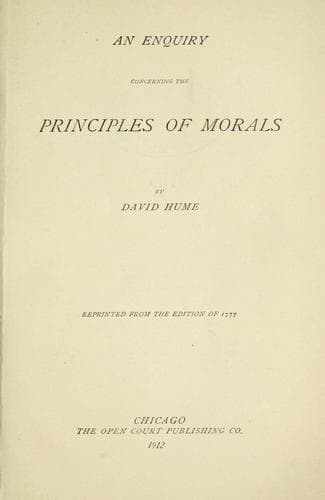
An Enquiry Concerning the Principles of MoralsHume, David
PhilosophyPhilosophy
An Enquiry Concerning the Principles of Morals
Hume, David
Conduct of life; Ethics
[Footnote: We ought not to imagine, because an inanimate object
may be useful as well as a man, that therefore it ought also, according
to this system, to merit he appellation of VIRTUOUS. The sentiments,
excited by utility, are, in the two cases, very different; and the one
is mixed with affection, esteem, approbation, &c., and not the other. In
like manner, an inanimate object may have good colour and proportions
as well as a human figure. But can we ever be in love with the former?
There are a numerous set of passions and sentiments, of which thinking
rational beings are, by the original constitution of nature, the only
proper objects: and though the very same qualities be transferred to an
insensible, inanimate being, they will not excite the same sentiments.
The beneficial qualities of herbs and minerals are, indeed, sometimes
called their VIRTUES; but this is an effect of the caprice of language,
which out not to be regarded in reasoning. For though there be a species
of approbation attending even inanimate objects, when beneficial, yet
this sentiment is so weak, and so different from that which is directed
to beneficent magistrates or statesman; that they ought not to be ranked
under the same class or appellation.
A very small variation of the object, even where the same qualities are
preserved, will destroy a sentiment. Thus, the same beauty, transferred
to a different sex, excites no amorous passion, where nature is not
extremely perverted.]
But perhaps the difficulty of accounting for these effects of
usefulness, or its contrary, has kept philosophers from admitting them
into their systems of ethics, and has induced them rather to employ any
other principle, in explaining the origin of moral good and evil. But it
is no just reason for rejecting any principle, confirmed by experience,
that we cannot give a satisfactory account of its origin, nor are able
to resolve it into other more general principles. And if we would
employ a little thought on the present subject, we need be at no loss to
account for the influence of utility, and to deduce it from principles,
the most known and avowed in human nature.
Public-domain text, read in full here on John Shaqi.
Reviews
Reviews
No reviews yet
Be the first to share your thoughts on this work.
Join the Discussion
Join the discussion
Sign in to leave a comment or review.
Sign InorCreate an account