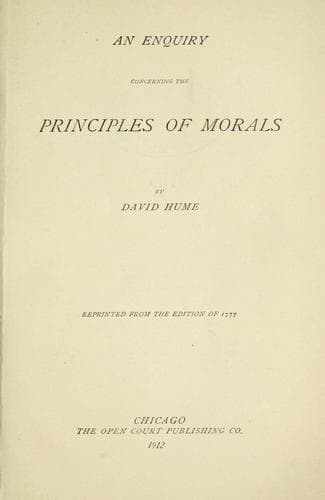
An Enquiry Concerning the Principles of Morals — John Shaqi
An Enquiry Concerning the Principles of MoralsHume, David
PhilosophyPhilosophy
An Enquiry Concerning the Principles of Morals
Hume, David
Conduct of life; Ethics
From the apparent usefulness of the social virtues, it has readily
been inferred by sceptics, both ancient and modern, that all moral
distinctions arise from education, and were, at first, invented, and
afterwards encouraged, by the art of politicians, in order to render
men tractable, and subdue their natural ferocity and selfishness, which
incapacitated them for society. This principle, indeed, of precept and
education, must so far be owned to have a powerful influence, that it
may frequently increase or diminish, beyond their natural standard,
the sentiments of approbation or dislike; and may even, in particular
instances, create, without any natural principle, a new sentiment of
this kind; as is evident in all superstitious practices and observances:
But that ALL moral affection or dislike arises from this origin, will
never surely be allowed by any judicious enquirer. Had nature made no
such distinction, founded on the original constitution of the mind, the
words, HONOURABLE and SHAMEFUL, LOVELY and ODIOUS, NOBLE and DESPICABLE,
had never had place in any language; nor could politicians, had they
invented these terms, ever have been able to render them intelligible,
or make them convey any idea to the audience. So that nothing can be
more superficial than this paradox of the sceptics; and it were well,
if, in the abstruser studies of logic and metaphysics, we could as
easily obviate the cavils of that sect, as in the practical and more
intelligible sciences of politics and morals.
The social virtues must, therefore, be allowed to have a natural
beauty and amiableness, which, at first, antecedent to all precept or
education, recommends them to the esteem of uninstructed mankind, and
engages their affections. And as the public utility of these virtues is
the chief circumstance, whence they derive their merit, it follows,
that the end, which they have a tendency to promote, must be some
way agreeable to us, and take hold of some natural affection. It must
please, either from considerations of self-interest, or from more
generous motives and regards.
It has often been asserted, that, as every man has a strong connexion
with society, and perceives the impossibility of his solitary
subsistence, he becomes, on that account, favourable to all those habits
or principles, which promote order in society, and insure to him the
quiet possession of so inestimable a blessing, As much as we value
our own happiness and welfare, as much must we applaud the practice
of justice and humanity, by which alone the social confederacy can
be maintained, and every man reap the fruits of mutual protection and
assistance.
Public-domain text, read in full here on John Shaqi.
Reviews
Reviews
No reviews yet
Be the first to share your thoughts on this work.
Join the Discussion
Join the discussion
Sign in to leave a comment or review.
Sign InorCreate an account