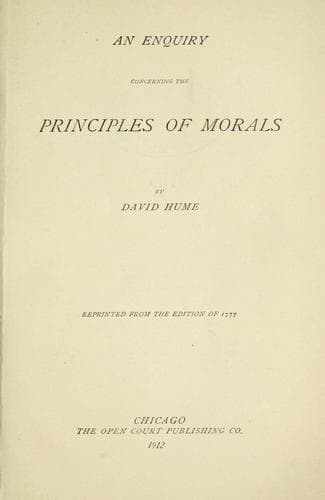
An Enquiry Concerning the Principles of MoralsHume, David
PhilosophyPhilosophy
An Enquiry Concerning the Principles of Morals
Hume, David
Conduct of life; Ethics
But though this question, concerning the general principles of morals,
be curious and important, it is needless for us, at present, to employ
farther care in our researches concerning it. For if we can be so happy,
in the course of this enquiry, as to discover the true origin of morals,
it will then easily appear how far either sentiment or reason enters
into all determinations of this nature [Footnote: See Appendix I]. In
order to attain this purpose, we shall endeavour to follow a very simple
method: we shall analyse that complication of mental qualities, which
form what, in common life, we call Personal Merit: we shall consider
every attribute of the mind, which renders a man an object either
of esteem and affection, or of hatred and contempt; every habit or
sentiment or faculty, which, if ascribed to any person, implies either
praise or blame, and may enter into any panegyric or satire of his
character and manners. The quick sensibility, which, on this head, is so
universal among mankind, gives a philosopher sufficient assurance, that
he can never be considerably mistaken in framing the catalogue, or incur
any danger of misplacing the objects of his contemplation: he needs only
enter into his own breast for a moment, and consider whether or not he
should desire to have this or that quality ascribed to him, and whether
such or such an imputation would proceed from a friend or an enemy.
The very nature of language guides us almost infallibly in forming a
judgement of this nature; and as every tongue possesses one set of words
which are taken in a good sense, and another in the opposite, the least
acquaintance with the idiom suffices, without any reasoning, to direct
us in collecting and arranging the estimable or blameable qualities of
men. The only object of reasoning is to discover the circumstances
on both sides, which are common to these qualities; to observe that
particular in which the estimable qualities agree on the one hand,
and the blameable on the other; and thence to reach the foundation of
ethics, and find those universal principles, from which all censure or
approbation is ultimately derived. As this is a question of fact, not
of abstract science, we can only expect success, by following the
experimental method, and deducing general maxims from a comparison
of particular instances. The other scientific method, where a general
abstract principle is first established, and is afterwards branched out
into a variety of inferences and conclusions, may be more perfect in
itself, but suits less the imperfection of human nature, and is a common
source of illusion and mistake in this as well as in other subjects.
Men are now cured of their passion for hypotheses and systems in natural
philosophy, and will hearken to no arguments but those which are derived
from experience. It is full time they should attempt a like reformation
in all moral disquisitions; and reject every system of ethics, however
Public-domain text, read in full here on John Shaqi.
Reviews
Reviews
No reviews yet
Be the first to share your thoughts on this work.
Join the Discussion
Join the discussion
Sign in to leave a comment or review.
Sign InorCreate an account