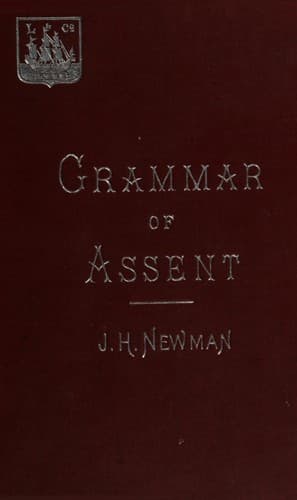
An Essay in Aid of a Grammar of AssentNewman, John Henry
Religion
An Essay in Aid of a Grammar of Assent
Newman, John Henry
Faith; Theism
(4.) A more plausible objection to the absolute absence of all doubt or
misgiving in an act of assent is found in the use of the terms firm and
weak assent, or in the growth of belief and trust. Thus, we assent to
the events of history, but not with that fulness and force of adherence
to the received account of them with which we realize a record of
occurrences which are within our own memory. And again, we assent
to the praise bestowed on a friend’s good qualities with an energy
which we do not feel, when we are speaking of virtue in the abstract:
and if we are political partisans, our assent is very cold, when we
cannot refuse it, to representations made in favour of the wisdom or
patriotism of statesmen whom we dislike. And then as to religious
subjects we speak of “strong” faith and “feeble” faith; of the faith
which would move mountains, and of the ordinary faith “without which it
is impossible to please God.” And as we can grow in graces, so surely
can we inclusively in faith. Again we rise from one work of Christian
Evidences with our faith enlivened and invigorated; from another
perhaps with the distracted father’s words in our mouth, “I believe,
help my unbelief.”
Now it is evident, first of all, that habits of mind may grow, as being
a something permanent and continuous; and by assent growing, it is
often only meant that the habit grows and has greater hold upon the
mind.
But again, when we carefully consider the matter, it will be found
that this increase or decrease of strength does not lie in the assent
itself, but in its circumstances and concomitants; for instance, in the
emotions, in the ratiocinative faculty, or in the imagination.
For instance, as to the emotions, this strength of assent may be
nothing more than the strength of love, hatred, interest, desire, or
fear, which the object of the assent elicits, and this is especially
the case when that object is of a religious nature. Such strength is
adventitious and accidental; it may come, it may go; it is found in one
man, not in another; it does not interfere with the genuineness and
perfection of the act of assent. Balaam assented to the fact of his
own intercourse with the supernatural, as well as Moses; but, to use
religious language, he had light without love; his intellect was clear,
his heart was cold. Hence his faith would popularly be considered
wanting in strength. On the other hand, prejudice implies strong
assents to the disadvantage of its object; that is, it encourages such
assents, and guards them from the chance of being lost.
Public-domain text, read in full here on John Shaqi.
Reviews
Reviews
No reviews yet
Be the first to share your thoughts on this work.
Elsewhere in the archive
Join the Discussion
Join the discussion
Sign in to leave a comment or review.
Sign InorCreate an account