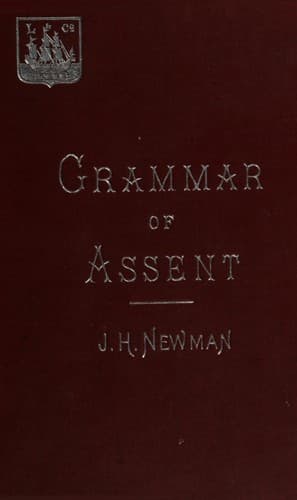
An Essay in Aid of a Grammar of AssentNewman, John Henry
Religion
An Essay in Aid of a Grammar of Assent
Newman, John Henry
Faith; Theism
2. Experience tells us only of individual things, and these things are
innumerable. Our minds might have been so constructed as to be able to
receive and retain an exact image of each of these various objects,
one by one, as it came before us, but only in and for itself, without
the power of comparing it with any of the others. But this is not our
case: on the contrary, to compare and to contrast are among the most
prominent and busy of our intellectual functions. Instinctively, even
though unconsciously, we are ever instituting comparisons between
the manifold phenomena of the external world, as we meet with them,
criticizing, referring to a standard, collecting, analyzing them. Nay,
as if by one and the same action, as soon as we perceive them, we
also perceive that they are like each other or unlike, or rather both
like and unlike at once. We apprehend spontaneously, even before we
set about apprehending, that man is like man, yet unlike; and unlike
a horse, a tree, a mountain, or a monument, yet in some, though not
the same respects, like each of them. And in consequence, as I have
said, we are ever grouping and discriminating, measuring and sounding,
framing cross classes and cross divisions, and thereby rising from
particulars to generals, that is from images to notions.
In processes of this kind we regard things, not as they are in
themselves, but mainly as they stand in relation to each other. We
look at nothing simply for its own sake; we cannot look at any one
thing without keeping our eyes on a multitude of other things besides.
“Man” is no longer what he really is, an individual presented to us by
our senses, but as we read him in the light of those comparisons and
contrasts which we have made him suggest to us. He is attenuated into
an aspect, or relegated to his place in a classification. Thus his
appellation is made to suggest, not the real being which he is in this
or that specimen of himself, but a definition. If I might use a harsh
metaphor, I should say he is made the logarithm of his true self, and
in that shape is worked with the ease and satisfaction of logarithms.
Public-domain text, read in full here on John Shaqi.
Reviews
Reviews
No reviews yet
Be the first to share your thoughts on this work.
Join the Discussion
Join the discussion
Sign in to leave a comment or review.
Sign InorCreate an account