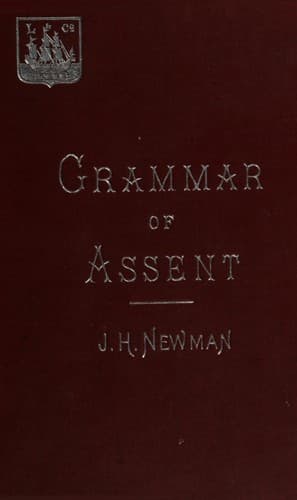
An Essay in Aid of a Grammar of AssentNewman, John Henry
Religion
An Essay in Aid of a Grammar of Assent
Newman, John Henry
Faith; Theism
any author’s life so deficient in biographical notices as his? We know
about Hooker, Spenser, Spelman, Raleigh, Harvey, his contemporaries:
what do we know of Shakespeare? Is he much more than a name? Is not
the traditional object of an Englishman’s idolatry after all a nebula
of genius, destined, like Homer, to be resolved into its separate and
independent luminaries, as soon as we have a criticism powerful enough
for the purpose? I must not be supposed for a moment to countenance
such scepticism myself,—though it is a subject worthy the attention
of a sceptical age: here I have introduced it simply to suggest how
many words go to make up a thoroughly valid argument; how short and
easy a way to a true conclusion is the logic of good sense; how little
syllogisms have to do with the formation of opinion; how little depends
upon the inferential proofs, and how much upon those pre-existing
beliefs and views, in which men either already agree with each other or
hopelessly differ, before they begin to dispute, and which are hidden
deep in our nature, or, it may be, in our personal peculiarities.
2.
So much on the multiplicity of assumptions, which in spite of formal
exactness, logical reasoning in concrete matters is forced to admit,
and on the consequent uncertainty which attends its conclusions. Now
I come to the second reason why its conclusions are thus wanting in
precision.
In this world of sense we have to do with things, far more than with
notions. We are not solitary, left to the contemplation of our own
thoughts and their legitimate developments. We are surrounded by
external beings, and our enunciations are directed to the concrete.
We reason in order to enlarge our knowledge of matters, which do not
depend on us for being what they are. But how is an exercise of mind,
which is for the most part occupied with notions, not things, competent
to deal with things, except partially and indirectly? This is the main
reason why an inference, however fully worded, (except perhaps in some
peculiar cases, which are out of place here,) never can reach so far
as to ascertain a fact. As I have already said, arguments about the
abstract cannot handle and determine the concrete. They may approximate
to a proof, but they only reach the probable, because they cannot reach
the particular.
Even in mathematical physics a margin is left for possible imperfection
in the investigation. When the planet Neptune was discovered, it was
deservedly considered a triumph of science, that abstract reasonings
had done so much towards determining the planet and its orbit. There
would have been no triumph in success, had there been no hazard of
failure; it is no triumph to Euclid, in pure mathematics, that the
geometrical conclusions of his second book can be worked out and
verified by algebra.
Public-domain text, read in full here on John Shaqi.
Reviews
Reviews
No reviews yet
Be the first to share your thoughts on this work.
Elsewhere in the archive
Join the Discussion
Join the discussion
Sign in to leave a comment or review.
Sign InorCreate an account