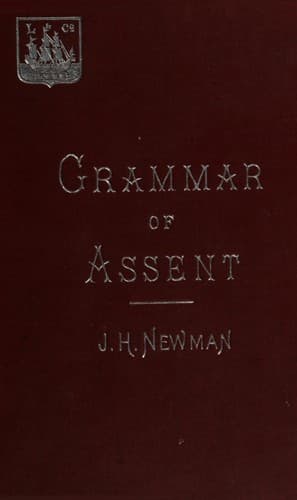
An Essay in Aid of a Grammar of AssentNewman, John Henry
Religion
An Essay in Aid of a Grammar of Assent
Newman, John Henry
Faith; Theism
I will accept the general proposition, but I resist its application.
Doubtless it is abstractedly more likely that men should lie than
that the order of nature should be infringed; but what is abstract
reasoning to a question of concrete fact? To arrive at the fact of any
matter, we must eschew generalities, and take things as they stand,
with all their circumstances. _À priori_, of course the acts of men
are not so trustworthy as the order of nature, and the pretence of
miracles is in fact more common than the occurrence. But the question
is not about miracles in general, or men in general, but definitely,
whether these particular miracles, ascribed to the particular Peter,
James, and John, are more likely to have been or not; whether they
are unlikely, supposing that there is a Power, external to the world,
who can bring them about; supposing they are the only means by which
He can reveal Himself to those who need a revelation; supposing He
is likely to reveal Himself; that He has a great end in doing so;
that the professed miracles in question are like His natural works,
and such as He is likely to work, in case He wrought miracles; that
great effects, otherwise unaccountable, in the event followed upon the
acts said to be miraculous; that they were from the first accepted as
true by large numbers of men against their natural interests; that
the reception of them as true has left its mark upon the world, as no
other event ever did; that, viewed in their effects, they have—that is,
the belief of them has—served to raise human nature to a high moral
standard, otherwise unattainable: these and the like considerations
are parts of a great complex argument, which so far can be put into
propositions, but which, even between, and around, and behind these,
still is implicit and secret, and cannot by any ingenuity be imprisoned
in a formula, and packed into a nut-shell. These various conditions may
be decided in the affirmative or in the negative. That is a further
point; here I only insist upon the nature of the argument, if it is to
be philosophical. It must be no smart antithesis which may look well on
paper, but the living action of the mind on a great problem of fact;
and we must summon to our aid all our powers and resources, if we would
encounter it worthily, and not as if it were a literary essay.
Public-domain text, read in full here on John Shaqi.
Reviews
Reviews
No reviews yet
Be the first to share your thoughts on this work.
Elsewhere in the archive
Join the Discussion
Join the discussion
Sign in to leave a comment or review.
Sign InorCreate an account