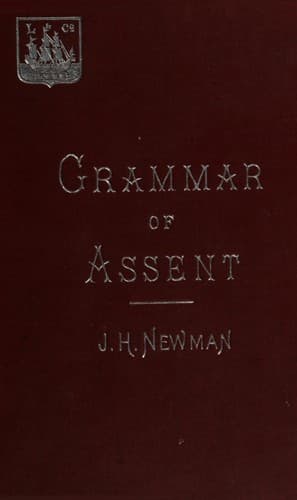
An Essay in Aid of a Grammar of AssentNewman, John Henry
Religion
An Essay in Aid of a Grammar of Assent
Newman, John Henry
Faith; Theism
Truths such as these, which are too obvious to be called irresistible,
are illustrated by what we see in universal nature. Every being is
in a true sense sufficient for itself, so as to be able to fulfil
its particular needs. It is a general law that, whatever is found as
a function or an attribute of any class of beings, or is natural to
it, is in its substance suitable to it, and subserves its existence,
and cannot be rightly regarded as a fault or enormity. No being could
endure, of which the constituent parts were at war with each other. And
more than this; there is that principle of vitality in every being,
which is of a sanative and restorative character, and which brings
all its parts and functions together into one whole, and is ever
repelling and correcting the mischiefs which befall it, whether from
within or without, while showing no tendency to cast off its belongings
as if foreign to its nature. The brute animals are found severally
with limbs and organs, habits, instincts, appetites, surroundings,
which play together for the safety and welfare of the whole; and,
after all exceptions, may be said each of them to have, after its
own kind, a perfection of nature. Man is the highest of the animals,
and more indeed than an animal, as having a mind; that is, he has a
complex nature different from theirs, with a higher aim and a specific
perfection; but still the fact that other beings find their good in the
use of their particular nature, is a reason for anticipating that to
use duly our own is our interest as well as our necessity.
What is the peculiarity of our nature, in contrast with the inferior
animals around us? It is that, though man cannot change what he is
born with, he is a being of progress with relation to his perfection
and characteristic good. Other beings are complete from their first
existence, in that line of excellence which is allotted to them; but
man begins with nothing realized (to use the word), and he has to
make capital for himself by the exercise of those faculties which are
his natural inheritance. Thus he gradually advances to the fulness of
his original destiny. Nor is this progress mechanical, nor is it of
necessity; it is committed to the personal efforts of each individual
of the species; each of us has the prerogative of completing his
inchoate and rudimental nature, and of developing his own perfection
out of the living elements with which his mind began to be. It is his
gift to be the creator of his own sufficiency; and to be emphatically
self-made. This is the law of his being, which he cannot escape; and
whatever is involved in that law he is bound, or rather he is carried
on, to fulfil.
Public-domain text, read in full here on John Shaqi.
Reviews
Reviews
No reviews yet
Be the first to share your thoughts on this work.
Elsewhere in the archive
Join the Discussion
Join the discussion
Sign in to leave a comment or review.
Sign InorCreate an account