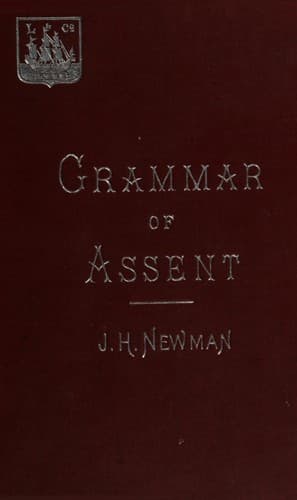
An Essay in Aid of a Grammar of AssentNewman, John Henry
Religion
An Essay in Aid of a Grammar of Assent
Newman, John Henry
Faith; Theism
Next, as to its relation to nature. As I have said, Christianity is
simply an addition to it; it does not supersede or contradict it; it
recognizes and depends on it, and that of necessity: for how possibly
can it prove its claims except by an appeal to what men have already?
be it ever so miraculous, it cannot dispense with nature; this would
be to cut the ground from under it; for what would be the worth of
evidences in favour of a revelation which denied the authority of that
system of thought, and those courses of reasoning, out of which those
evidences necessarily grew?
And in agreement with this obvious conclusion we find in Scripture our
Lord and His Apostles always treating Christianity as the completion
and supplement of Natural Religion, and of previous revelations; as
when He says that the Father testified of Him; that not to know Him
was not to know the Father; and as St. Paul at Athens appeals to the
“Unknown God,” and says that “He that made the world” “now declareth
to all men to do penance, because He hath appointed a day to judge
the world by the man whom He hath appointed.” As then our Lord and
His Apostles appeal to the God of nature, we must follow them in that
appeal; and, to do this with the better effect, we must first inquire
into the chief doctrines and the grounds of Natural Religion.
§ 1. Natural Religion.
By Religion I mean the knowledge of God, of His Will, and of our duties
towards Him; and there are three main channels which Nature furnishes
for our acquiring this knowledge, viz. our own minds, the voice of
mankind, and the course of the world, that is, of human life and human
affairs. The informations which these three convey to us teach us the
Being and Attributes of God, our responsibility to Him, our dependence
on Him, our prospect of reward or punishment, to be somehow brought
about, according as we obey or disobey Him. And the most authoritative
of these three means of knowledge, as being specially our own, is
our own mind, whose informations give us the rule by which we test,
interpret, and correct what is presented to us for belief, whether by
the universal testimony of mankind, or by the history of society and of
the world.
Public-domain text, read in full here on John Shaqi.
Reviews
Reviews
No reviews yet
Be the first to share your thoughts on this work.
Elsewhere in the archive
Join the Discussion
Join the discussion
Sign in to leave a comment or review.
Sign InorCreate an account