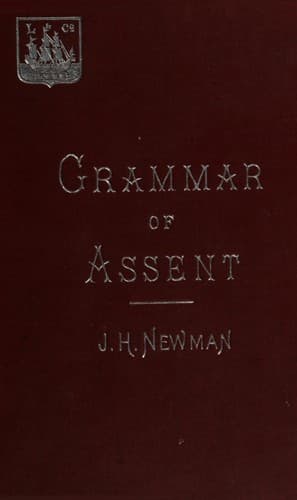
An Essay in Aid of a Grammar of AssentNewman, John Henry
Religion
An Essay in Aid of a Grammar of Assent
Newman, John Henry
Faith; Theism
2. Next, as to the proposition, that things exist external to
ourselves, this I do consider a first principle, and one of universal
reception. It is founded on an instinct; I so call it, because the
brute creation possesses it. This instinct is directed towards
individual phenomena, one by one, and has nothing of the character of
a generalization; and, since it exists in brutes, the gift of reason
is not a condition of its existence, and it may justly be considered
an instinct in man. What the human mind does is what brutes cannot
do, viz. to draw from our ever-recurring experiences of its testimony
in particulars a general proposition, and, because this instinct or
intuition acts whenever the phenomena of sense present themselves, to
lay down in broad terms, by an inductive process, the great aphorism,
that there is an external world, and that all the phenomena of sense
proceed from it. This general proposition, to which we go on to assent,
goes (_extensivè_, though not _intensivè_) far beyond our experience,
illimitable as that experience may be, and represents a notion.
3. I have spoken, and I think rightly spoken, of instinct as a force
which spontaneously impels us, not only to bodily movements, but to
mental acts. It is instinct which leads the quasi-intelligent principle
(whatever it is) in brutes to perceive in the phenomena of sense a
something distinct from and beyond those phenomena. It is instinct
which impels the child to recognize in the smiles or the frowns of
a countenance which meets his eyes, not only a being external to
himself, but one whose looks elicit in him confidence or fear. And,
as he instinctively interprets these physical phenomena, as tokens
of things beyond themselves, so from the sensations attendant upon
certain classes of his thoughts and actions he gains a perception of
an external being, who reads his mind, to whom he is responsible,
who praises and blames, who promises and threatens. As I am only
illustrating a general view by examples, I shall take this analogy for
granted here. As then we have our initial knowledge of the universe
through sense, so do we in the first instance begin to learn about its
Lord and God from conscience; and, as from particular acts of that
instinct, which makes experiences, mere images (as they ultimately are)
upon the retina, the means of our perceiving something real beyond
them, we go on to draw the general conclusion that there is a vast
external world, so from the recurring instances in which conscience
acts, forcing upon us importunately the mandate of a Superior, we have
fresh and fresh evidence of the existence of a Sovereign Ruler, from
whom those particular dictates which we experience proceed; so that,
with limitations which cannot here be made without digressing from
my main subject, we may, by means of that induction from particular
experiences of conscience, have as good a warrant for concluding the
Public-domain text, read in full here on John Shaqi.
Reviews
Reviews
No reviews yet
Be the first to share your thoughts on this work.
Join the Discussion
Join the discussion
Sign in to leave a comment or review.
Sign InorCreate an account