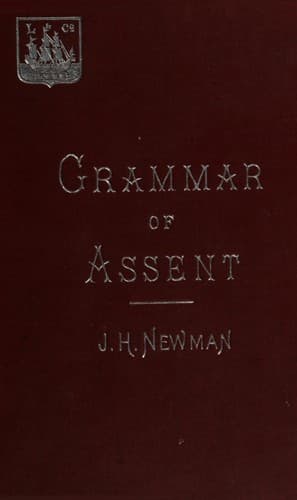
An Essay in Aid of a Grammar of AssentNewman, John Henry
Religion
An Essay in Aid of a Grammar of Assent
Newman, John Henry
Faith; Theism
Moreover, this image brought before his mental vision is the image
of One who by implicit threat and promise commands certain things
which he, the same child, coincidently, by the same act of his mind,
approves; which receive the adhesion of his moral sense and judgment,
as right and good. It is the image of One who is good, inasmuch
as enjoining and enforcing what is right and good, and who, in
consequence, not only excites in the child hope and fear,—nay (it may
be added), gratitude towards Him, as giving a law and maintaining it by
reward and punishment,—but kindles in him love towards Him, as giving
him a good law, and therefore as being good Himself, for it is the
property of goodness to kindle love, or rather the very object of love
is goodness; and all those distinct elements of the moral law, which
the typical child, whom I am supposing, more or less consciously loves
and approves,—truth, purity, justice, kindness, and the like,—are but
shapes and aspects of goodness. And having in his degree a sensibility
towards them all, for the sake of them all he is moved to love the
Lawgiver, who enjoins them upon him. And, as he can contemplate
these qualities and their manifestations under the common name of
goodness, he is prepared to think of them as indivisible, correlative,
supplementary of each other in one and the same Personality, so that
there is no aspect of goodness which God is not; and that the more,
because the notion of a perfection embracing all possible excellences,
both moral and intellectual, is especially congenial to the mind, and
there are in fact intellectual attributes, as well as moral, included
in the child’s image of God, as above represented.
Such is the apprehension which even a child may have of his Sovereign
Lawgiver and Judge; which is possible in the case of children, because,
at least, some children possess it, whether others possess it or no;
and which, when it is found in children, is found to act promptly and
keenly, by reason of the paucity of their ideas. It is an image of the
good God, good in Himself, good relatively to the child, with whatever
incompleteness; an image before it has been reflected on, and before it
is recognized by him as a notion. Though he cannot explain or define
the word “God,” when told to use it, his acts show that to him it is
far more than a word. He listens, indeed, with wonder and interest to
fables or tales; he has a dim, shadowy sense of what he hears about
persons and matters of this world; but he has that within him which
actually vibrates, responds, and gives a deep meaning to the lessons of
his first teachers about the will and the providence of God.
Public-domain text, read in full here on John Shaqi.
Reviews
Reviews
No reviews yet
Be the first to share your thoughts on this work.
Elsewhere in the archive
Join the Discussion
Join the discussion
Sign in to leave a comment or review.
Sign InorCreate an account