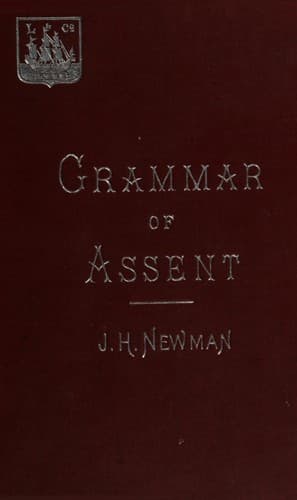
An Essay in Aid of a Grammar of AssentNewman, John Henry
Religion
An Essay in Aid of a Grammar of Assent
Newman, John Henry
Faith; Theism
with a real assent, what stands for things, not for notions only, is
each of those propositions taken one by one, and that, not in the
case of intellectual and thoughtful minds only, but of all religious
minds whatever, in the case of a child or a peasant, as well as of a
philosopher.
This is only one instance of a general principle which holds good
in all such real apprehension as is possible to us, of God and His
Attributes. Not only do we see Him at best only in shadows, but we
cannot bring even those shadows together, for they flit to and fro,
and are never present to us at once. We can indeed combine the various
matters which we know of Him by an act of the intellect, and treat them
theologically, but such theological combinations are no objects for the
imagination to gaze upon. Our image of Him never is one, but broken
into numberless partial aspects, independent each of each. As we cannot
see the whole starry firmament at once, but have to turn ourselves
from east to west, and then round to east again, sighting first one
constellation and then another, and losing these in order to gain
those, so it is, and much more, with such real apprehensions as we can
secure of the Divine Nature. We know one truth about Him and another
truth,—but we cannot image both of them together; we cannot bring them
before us by one act of the mind; we drop the one while we turn to take
up the other. None of them are fully dwelt on and enjoyed, when they
are viewed in combination. Moreover, our devotion is tried and confused
by the long list of propositions which theology is obliged to draw up,
by the limitations, explanations, definitions, adjustments, balancings,
cautions, arbitrary prohibitions, which are imperatively required by
the weakness of human thought and the imperfections of human language.
Such exercises of reasoning indeed do but increase and harmonize
our notional apprehension of the dogma, but they add little to the
luminousness and vital force with which its separate propositions come
home to our imagination, and if they are necessary, as they certainly
are, they are necessary not so much for faith, as against unbelief.
Public-domain text, read in full here on John Shaqi.
Reviews
Reviews
No reviews yet
Be the first to share your thoughts on this work.
Elsewhere in the archive
Join the Discussion
Join the discussion
Sign in to leave a comment or review.
Sign InorCreate an account