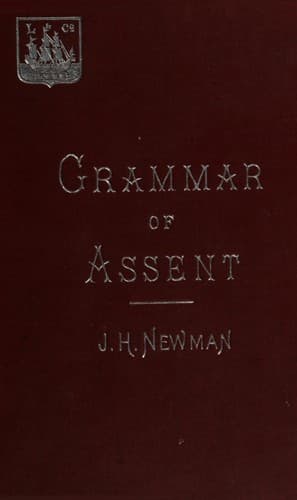
An Essay in Aid of a Grammar of AssentNewman, John Henry
Religion
An Essay in Aid of a Grammar of Assent
Newman, John Henry
Faith; Theism
Break a ray of light into its constituent colours, each is beautiful,
each may be enjoyed; attempt to unite them, and perhaps you produce
only a dirty white. The pure and indivisible Light is seen only by the
blessed inhabitants of heaven; here we have but such faint reflections
of it as its diffraction supplies; but they are sufficient for faith
and devotion. Attempt to combine them into one, and you gain nothing
but a mystery, which you can describe as a notion, but cannot depict as
an imagination. And this, which holds of the Divine Attributes, holds
also of the Holy Trinity in Unity. And hence, perhaps, it is that the
latter doctrine is never spoken of as a Mystery in the New Testament,
which is addressed far more to the imagination and affections than to
the intellect. Hence, too, what is more remarkable, the dogma is not
called a mystery in the Creeds; not in the Apostles’ nor the Nicene,
nor even in the Athanasian. The reason seems to be, that the Creeds
have a place in the Ritual; they are devotional acts, and of the nature
of prayers, addressed to God; and, in such addresses, to speak of
intellectual difficulties would be out of place. It must be recollected
especially that the Athanasian Creed has sometimes been called the
“Psalmus _Quicunque_.” It is not a mere collection of notions, however
momentous. It is a psalm or hymn of praise, of confession, and of
profound, self-prostrating homage, parallel to the canticles of the
elect in the Apocalypse. It appeals to the imagination quite as much
as to the intellect. It is the war-song of faith, with which we warn
first ourselves, then each other, and then all those who are within its
hearing, and the hearing of the Truth, who our God is, and how we must
worship Him, and how vast our responsibility will be, if we know what
to believe, and yet believe not. It is
“The Psalm that gathers in one glorious lay
All chants that e’er from heaven to earth found way;
Creed of the Saints, and Anthem of the Blest,
And calm-breathed warning of the kindliest love
That ever heaved a wakeful mother’s breast.”
For myself, I have ever felt it as the most simple and sublime, the
most devotional formulary to which Christianity has given birth,
more so even than the _Veni Creator_ and the _Te Deum_. Even the
antithetical form of its sentences, which is a stumbling-block to
so many, as seeming to force, and to exult in forcing a mystery
upon recalcitrating minds, has to my apprehension, even notionally
considered, a very different drift. It is intended as a check upon our
reasonings, lest they rush on in one direction beyond the limits of the
truth, and it turns them back into the opposite direction. Certainly it
implies a glorying in the Mystery; but it is not simply a statement of
the Mystery for the sake of its mysteriousness.
Public-domain text, read in full here on John Shaqi.
Reviews
Reviews
No reviews yet
Be the first to share your thoughts on this work.
Elsewhere in the archive
Join the Discussion
Join the discussion
Sign in to leave a comment or review.
Sign InorCreate an account