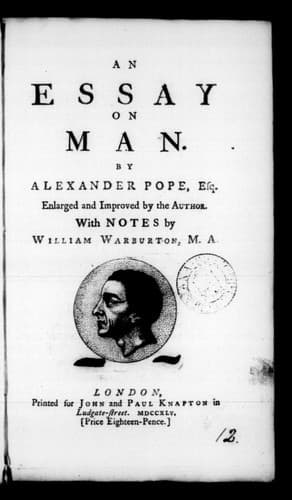
An Essay on Man; Moral Essays and SatiresPope, Alexander
ReligionComparative
An Essay on Man; Moral Essays and Satires
Pope, Alexander
English poetry -- 18th century
AN ESSAY ON MAN.
MORAL ESSAYS AND SATIRES
BY
ALEXANDER POPE.
CASSELL & COMPANY, LIMITED:
_LONDON_, _PARIS & MELBOURNE_.
1891.
INTRODUCTION.
Pope's life as a writer falls into three periods, answering fairly enough
to the three reigns in which he worked. Under Queen Anne he was an
original poet, but made little money by his verses; under George I. he
was chiefly a translator, and made much money by satisfying the French-
classical taste with versions of the "Iliad" and "Odyssey." Under George
I. he also edited Shakespeare, but with little profit to himself; for
Shakespeare was but a Philistine in the eyes of the French-classical
critics. But as the eighteenth century grew slowly to its work, signs of
a deepening interest in the real issues of life distracted men's
attention from the culture of the snuff-box and the fan. As Pope's
genius ripened, the best part of the world in which he worked was
pressing forward, as a mariner who will no longer hug the coast but
crowds all sail to cross the storms of a wide unknown sea. Pope's poetry
thus deepened with the course of time, and the third period of his life,
which fell within the reign of George II., was that in which he produced
the "Essay on Man," the "Moral Essays," and the "Satires." These deal
wholly with aspects of human life and the great questions they raise,
according throughout with the doctrine of the poet, and of the reasoning
world about him in his latter day, that "the proper study of mankind is
Man."
Wrongs in high places, and the private infamy of many who enforced the
doctrines of the Church, had produced in earnest men a vigorous
antagonism. Tyranny and unreason of low-minded advocates had brought
religion itself into question; and profligacy of courtiers, each
worshipping the golden calf seen in his mirror, had spread another form
of scepticism. The intellectual scepticism, based upon an honest search
for truth, could end only in making truth the surer by its questionings.
The other form of scepticism, which might be traced in England from the
low-minded frivolities of the court of Charles the Second, was widely
spread among the weak, whose minds flinched from all earnest thought.
They swelled the number of the army of bold questioners upon the ways of
God to Man, but they were an idle rout of camp-followers, not combatants;
they simply ate, and drank, and died.
Public-domain text, read in full here on John Shaqi.
Reviews
Reviews
No reviews yet
Be the first to share your thoughts on this work.
Join the Discussion
Join the discussion
Sign in to leave a comment or review.
Sign InorCreate an account