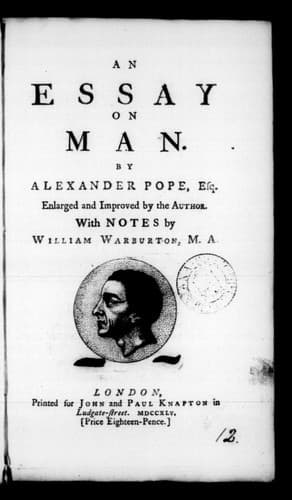
An Essay on Man; Moral Essays and SatiresPope, Alexander
ReligionComparative
An Essay on Man; Moral Essays and Satires
Pope, Alexander
English poetry -- 18th century
In 1697, Pierre Bayle published at Rotterdam, his "Historical and
Critical Dictionary," in which the lives of men were associated with a
comment that suggested, from the ills of life, the absence of divine care
in the shaping of the world. Doubt was born of the corruption of
society; Nature and Man were said to be against faith in the rule of a
God, wise, just, and merciful. In 1710, after Bayle's death, Leibnitz, a
German philosopher then resident in Paris, wrote in French a book, with a
title formed from Greek words meaning Justice of God, Theodicee, in which
he met Bayle's argument by reasoning that what we cannot understand
confuses us, because we see only the parts of a great whole. Bayle, he
said, is now in Heaven, and from his place by the throne of God, he sees
the harmony of the great Universe, and doubts no more. We see only a
little part in which are many details that have purposes beyond our ken.
The argument of Leibnitz's Theodicee was widely used; and although Pope
said that he had never read the Theodicee, his "Essay on Man" has a like
argument. When any book has a wide influence upon opinion, its general
ideas pass into the minds of many people who have never read it. Many
now talk about evolution and natural selection, who have never read a
line of Darwin.
In the reign of George the Second, questionings did spread that went to
the roots of all religious faith, and many earnest minds were busying
themselves with problems of the state of Man, and of the evidence of God
in the life of man, and in the course of Nature. Out of this came,
nearly at the same time, two works wholly different in method and in
tone--so different, that at first sight it may seem absurd to speak of
them together. They were Pope's "Essay on Man," and Butler's "Analogy of
Religion, Natural and Revealed, to the Constitution and Course of
Nature."
Public-domain text, read in full here on John Shaqi.
Reviews
Reviews
No reviews yet
Be the first to share your thoughts on this work.
Join the Discussion
Join the discussion
Sign in to leave a comment or review.
Sign InorCreate an account