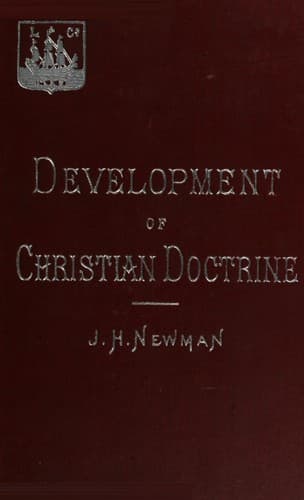
An Essay on the Development of Christian DoctrineNewman, John Henry
Religion
An Essay on the Development of Christian Doctrine
Newman, John Henry
Catholic Church -- Doctrines; Dogma, Development of
Now there was this cardinal distinction between Christianity and the
religions and philosophies by which it was surrounded, nay even the
Judaism of the day, that it referred all truth and revelation to one
source, and that the Supreme and Only God. Pagan rites which honoured
one or other out of ten thousand deities; philosophies which scarcely
taught any source of revelation at all; Gnostic heresies which were
based on Dualism, adored angels, or ascribed the two Testaments to
distinct authors, could not regard truth as one, unalterable,
consistent, imperative, and saving. But Christianity started with the
principle that there was but "one God and one Mediator," and that He,
"who at sundry times and in divers manners spake in time past unto the
fathers by the Prophets, had in these last days spoken unto us by His
Son." He had never left Himself without witness, and now He had come,
not to undo the past, but to fulfil and perfect it. His Apostles, and
they alone, possessed, venerated, and protected a Divine Message, as
both sacred and sanctifying; and, in the collision and conflict of
opinions, in ancient times or modern, it was that Message, and not any
vague or antagonist teaching, that was to succeed in purifying,
assimilating, transmuting, and taking into itself the many-coloured
beliefs, forms of worship, codes of duty, schools of thought, through
which it was ever moving. It was Grace, and it was Truth.
§ 1. _The Assimilating Power of Dogmatic Truth._
That there is a truth then; that there is one truth; that religious
error is in itself of an immoral nature; that its maintainers, unless
involuntarily such, are guilty in maintaining it; that it is to be
dreaded; that the search for truth is not the gratification of
curiosity; that its attainment has nothing of the excitement of a
discovery; that the mind is below truth, not above it, and is bound, not
to descant upon it, but to venerate it; that truth and falsehood are set
before us for the trial of our hearts; that our choice is an awful
giving forth of lots on which salvation or rejection is inscribed; that
"before all things it is necessary to hold the Catholic faith;" that "he
that would be saved must thus think," and not otherwise; that, "if thou
criest after knowledge, and liftest up thy voice for understanding, if
thou seekest her as silver, and searchest for her as for hid treasure,
then shalt thou understand the fear of the Lord, and find the knowledge
of God,"--this is the dogmatical principle, which has strength.
Public-domain text, read in full here on John Shaqi.
Reviews
Reviews
No reviews yet
Be the first to share your thoughts on this work.
Elsewhere in the archive
Join the Discussion
Join the discussion
Sign in to leave a comment or review.
Sign InorCreate an account