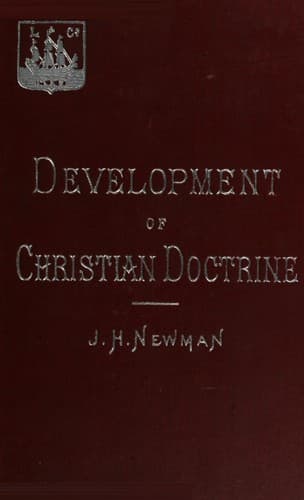
An Essay on the Development of Christian DoctrineNewman, John Henry
Religion
An Essay on the Development of Christian Doctrine
Newman, John Henry
Catholic Church -- Doctrines; Dogma, Development of
That truth and falsehood in religion are but matter of opinion; that one
doctrine is as good as another; that the Governor of the world does not
intend that we should gain the truth; that there is no truth; that we
are not more acceptable to God by believing this than by believing that;
that no one is answerable for his opinions; that they are a matter of
necessity or accident; that it is enough if we sincerely hold what we
profess; that our merit lies in seeking, not in possessing; that it is
a duty to follow what seems to us true, without a fear lest it should
not be true; that it may be a gain to succeed, and can be no harm to
fail; that we may take up and lay down opinions at pleasure; that belief
belongs to the mere intellect, not to the heart also; that we may safely
trust to ourselves in matters of Faith, and need no other guide,--this
is the principle of philosophies and heresies, which is very weakness.
2.
Two opinions encounter; each may be abstractedly true; or again, each
may be a subtle, comprehensive doctrine, vigorous, elastic, expansive,
various; one is held as a matter of indifference, the other as a matter
of life and death; one is held by the intellect only, the other also by
the heart: it is plain which of the two must succumb to the other. Such
was the conflict of Christianity with the old established Paganism,
which was almost dead before Christianity appeared; with the Oriental
Mysteries, flitting wildly to and fro like spectres; with the Gnostics,
who made Knowledge all in all, despised the many, and called Catholics
mere children in the Truth; with the Neo-platonists, men of literature,
pedants, visionaries, or courtiers; with the Manichees, who professed to
seek Truth by Reason, not by Faith; with the fluctuating teachers of the
school of Antioch, the time-serving Eusebians, and the reckless
versatile Arians; with the fanatic Montanists and harsh Novatians, who
shrank from the Catholic doctrine, without power to propagate their own.
These sects had no stay or consistence, yet they contained elements of
truth amid their error, and had Christianity been as they, it might have
resolved into them; but it had that hold of the truth which gave its
teaching a gravity, a directness, a consistency, a sternness, and a
force, to which its rivals for the most part were strangers. It could
not call evil good, or good evil, because it discerned the difference
between them; it could not make light of what was so solemn, or desert
what was so solid. Hence, in the collision, it broke in pieces its
antagonists, and divided the spoils.
3.
Public-domain text, read in full here on John Shaqi.
Reviews
Reviews
No reviews yet
Be the first to share your thoughts on this work.
Elsewhere in the archive
Join the Discussion
Join the discussion
Sign in to leave a comment or review.
Sign InorCreate an account