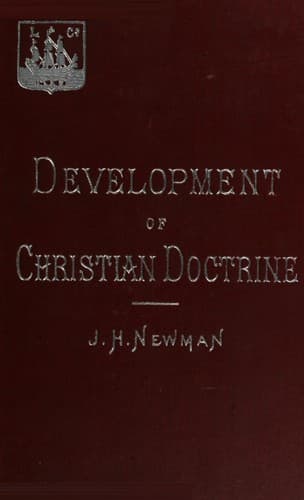
An Essay on the Development of Christian DoctrineNewman, John Henry
Religion
An Essay on the Development of Christian Doctrine
Newman, John Henry
Catholic Church -- Doctrines; Dogma, Development of
salvation of the elect, or mental liberty, or the union of the soul with
God. If, indeed, it is only thereby meant to use one or other of these
as a central idea for convenience, in order to group others around it,
no fault can be found with such a proceeding: and in this sense I should
myself call the Incarnation the central aspect of Christianity, out of
which the three main aspects of its teaching take their rise, the
sacramental, the hierarchical, and the ascetic. But one aspect of
Revelation must not be allowed to exclude or to obscure another; and
Christianity is dogmatical, devotional, practical all at once; it is
esoteric and exoteric; it is indulgent and strict; it is light and dark;
it is love, and it is fear.
4.
When an idea, whether real or not, is of a nature to arrest and possess
the mind, it may be said to have life, that is, to live in the mind
which is its recipient. Thus mathematical ideas, real as they are, can
hardly properly be called living, at least ordinarily. But, when some
great enunciation, whether true or false, about human nature, or present
good, or government, or duty, or religion, is carried forward into the
public throng of men and draws attention, then it is not merely received
passively in this or that form into many minds, but it becomes an active
principle within them, leading them to an ever-new contemplation of
itself, to an application of it in various directions, and a propagation
of it on every side. Such is the doctrine of the divine right of kings,
or of the rights of man, or of the anti-social bearings of a priesthood,
or utilitarianism, or free trade, or the duty of benevolent enterprises,
or the philosophy of Zeno or Epicurus, doctrines which are of a nature
to attract and influence, and have so far a _primâ facie_ reality, that
they may be looked at on many sides and strike various minds very
variously. Let one such idea get possession of the popular mind, or the
mind of any portion of the community, and it is not difficult to
understand what will be the result. At first men will not fully realize
what it is that moves them, and will express and explain themselves
inadequately. There will be a general agitation of thought, and an
action of mind upon mind. There will be a time of confusion, when
conceptions and misconceptions are in conflict, and it is uncertain
whether anything is to come of the idea at all, or which view of it is
to get the start of the others. New lights will be brought to bear upon
the original statements of the doctrine put forward; judgments and
aspects will accumulate. After a while some definite teaching emerges;
and, as time proceeds, one view will be modified or expanded by another,
and then combined with a third; till the idea to which these various
aspects belong, will be to each mind separately what at first it was
only to all together. It will be surveyed too in its relation to other
doctrines or facts, to other natural laws or established customs, to the
Public-domain text, read in full here on John Shaqi.
Reviews
Reviews
No reviews yet
Be the first to share your thoughts on this work.
Join the Discussion
Join the discussion
Sign in to leave a comment or review.
Sign InorCreate an account