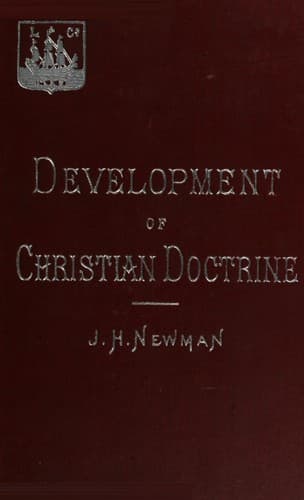
An Essay on the Development of Christian DoctrineNewman, John Henry
Religion
An Essay on the Development of Christian Doctrine
Newman, John Henry
Catholic Church -- Doctrines; Dogma, Development of
varying circumstances of times and places, to other religions, polities,
philosophies, as the case may be. How it stands affected towards other
systems, how it affects them, how far it may be made to combine with
them, how far it tolerates them, when it interferes with them, will be
gradually wrought out. It will be interrogated and criticized by
enemies, and defended by well-wishers. The multitude of opinions formed
concerning it in these respects and many others will be collected,
compared, sorted, sifted, selected, rejected, gradually attached to it,
separated from it, in the minds of individuals and of the community. It
will, in proportion to its native vigour and subtlety, introduce itself
into the framework and details of social life, changing public opinion,
and strengthening or undermining the foundations of established order.
Thus in time it will have grown into an ethical code, or into a system
of government, or into a theology, or into a ritual, according to its
capabilities: and this body of thought, thus laboriously gained, will
after all be little more than the proper representative of one idea,
being in substance what that idea meant from the first, its complete
image as seen in a combination of diversified aspects, with the
suggestions and corrections of many minds, and the illustration of many
experiences.
5.
This process, whether it be longer or shorter in point of time, by which
the aspects of an idea are brought into consistency and form, I call its
development, being the germination and maturation of some truth or
apparent truth on a large mental field. On the other hand this process
will not be a development, unless the assemblage of aspects, which
constitute its ultimate shape, really belongs to the idea from which
they start. A republic, for instance, is not a development from a pure
monarchy, though it may follow upon it; whereas the Greek "tyrant" may
be considered as included in the idea of a democracy. Moreover a
development will have this characteristic, that, its action being in the
busy scene of human life, it cannot progress at all without cutting
across, and thereby destroying or modifying and incorporating with
itself existing modes of thinking and operating. The development then of
an idea is not like an investigation worked out on paper, in which each
successive advance is a pure evolution from a foregoing, but it is
carried on through and by means of communities of men and their leaders
and guides; and it employs their minds as its instruments, and depends
upon them, while it uses them. And so, as regards existing opinions,
principles, measures, and institutions of the community which it has
invaded; it developes by establishing relations between itself and
them; it employs itself, in giving them a new meaning and direction, in
creating what may be called a jurisdiction over them, in throwing off
whatever in them it cannot assimilate. It grows when it incorporates,
Public-domain text, read in full here on John Shaqi.
Reviews
Reviews
No reviews yet
Be the first to share your thoughts on this work.
Join the Discussion
Join the discussion
Sign in to leave a comment or review.
Sign InorCreate an account