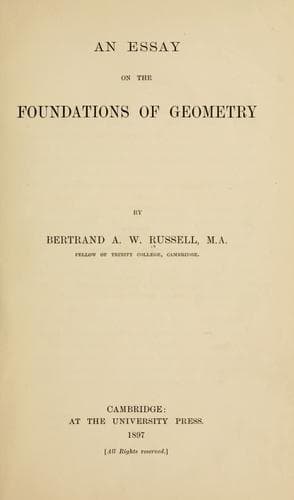
An essay on the foundations of geometryRussell, Bertrand
Philosophy
An essay on the foundations of geometry
Russell, Bertrand
Geometry -- Foundations
186. Would this be unknowable without a given form of
externality? 182
187. Bradley has proved that space and time preclude the
existence of mere particulars, 182
188. And that knowledge requires the _This_ to be neither simple
nor self-subsistent 183
189. To prove that experience requires a form of externality, I
assume that all knowledge requires the recognition of identity in
difference 184
190. Such recognition involves time 184
191. And some other form giving simultaneous diversity 185
192. The above argument has not deduced sense-perception from
the categories, but has shown the former, unless it contains
a certain element, to be unintelligible to the latter 186
193. How to account for the realization of this element, is a
question for metaphysics 187
194. What are we to do with the contradictions in space? 188
195. Three contradictions will be discussed in what follows 188
196. (1) The antinomy of the Point proves the relativity of
space, 189
197. And shows that Geometry must have some reference to
matter, 190
198. By which means it is made to refer to spatial order, not
to empty space 191
199. The causal properties of matter are irrelevant to Geometry,
which must regard it as composed of unextended atoms,
by which points are replaced 191
200. (2) The circle in defining straight lines and planes is
overcome by the same reference to matter 192
201. (3) The antinomy that space is relational and yet more
than relational, 193
202. Seems to depend on the confusion of empty space with
spatial order 193
203. Kant regarded empty space as the subject-matter of Geometry, 194
204. But the arguments of the Aesthetic are inconclusive on this
point, 195
205. And are upset by the mathematical antinomies, which prove
that spatial order should be the subject-matter of Geometry 196
206. The apparent thinghood of space is a psychological illusion,
due to the fact that spatial relations are immediately given 196
207. The apparent divisibility of spatial relations is either an
illusion, arising out of empty space, or the expression of the
possibility of quantitatively different spatial relations 197
Public-domain text, read in full here on John Shaqi.
Reviews
Reviews
No reviews yet
Be the first to share your thoughts on this work.
Join the Discussion
Join the discussion
Sign in to leave a comment or review.
Sign InorCreate an account