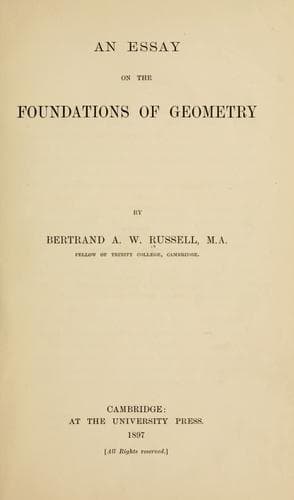
An essay on the foundations of geometryRussell, Bertrand
Philosophy
An essay on the foundations of geometry
Russell, Bertrand
Geometry -- Foundations
Suppose, he says, a north and south pole, _N_ and _S_, arbitrarily
fixed, and an equator _EW_. Suppose a being, _B_, capable of
impressions only from things on the surface of the sphere, to move
in a meridian _NBS_. Let _B_ start from some point _a_, and finally,
after describing a great circle, return to the same point _a_. If
_a_ is known only by the quality of the impression it makes on _B_,
_B_ may imagine he has not reached the same point _a_, but another
similar point _a′_, bearing a relation to _a_ similar to that of
the octave in singing: he might even not arrange his impressions
spatially at all. In order that this may occur, we require the
further assumption, that every difference in the above-mentioned
feelings (as he describes the meridian) may be presented as a spatial
distance between two places. Even now, _B_ may think he is describing
a Euclidean straight line, containing similar points at certain
intervals. Allowing, however, that he realizes the identity of _a_
with his initial position, he will now seem, by motion in a straight
line, to have returned to the point from which he started, for his
motion cannot, without the third dimension, seem to him other than
rectilinear.
Up to this point, there seems little ground for objection, except,
perhaps, to the idea of a straight line with periodical similar
points--if _B_ were as philosophical as, in these discussions,
we usually suppose him to be, he would probably object to this
interpretation of his experiences, on the ground that it regards
empty space as something independent of the objects in it. It is
worth pointing out, also, that _B_ would not need to describe the
whole circle, in order suddenly to find himself home again with his
old friends. Accurate measurements of small triangles would suffice
to determine his space-constant, and show him the length of a great
circle (or straight line, as he would call it). We must admit, also,
that so hypothetical a being as _B_ might form no space-intuition at
all, but as he is introduced solely for the purposes of the analogy,
it is convenient to allow him all possible qualifications for his
post. But these points do not touch the kernel of the argument, which
lies in the statement that such a straight line, returning into
itself after a finite time, would appear to _B_ as an "unendurable
contradiction," and thus force him, for logical though not for
sensational purposes, into the assumption of a third dimension. This
assertion seems to me quite unwarranted: the whole of Metageometry
is a solid array in disproof of it. Helmholtz's argument is, it must
be remembered, only an analogy, and the contradiction would exist
_only_ for a Euclidean. A complete _three_-dimensional Geometry has,
we have seen in Chapter I., been developed on the assumption that
straight lines are of finite length. A _constant_ value for the
measure of curvature, as our discussion of Riemann showed, involves
Public-domain text, read in full here on John Shaqi.
Reviews
Reviews
No reviews yet
Be the first to share your thoughts on this work.
Elsewhere in the archive
Join the Discussion
Join the discussion
Sign in to leave a comment or review.
Sign InorCreate an account