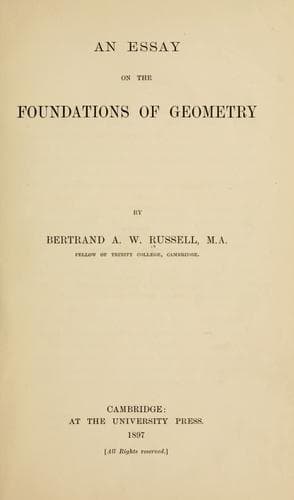
An essay on the foundations of geometryRussell, Bertrand
Philosophy
An essay on the foundations of geometry
Russell, Bertrand
Geometry -- Foundations
neither reference to the fourth dimension, nor any kind of internal
contradiction. This fact disproves Lotze's contention, which arises
solely from inability to divest his imagination of Euclidean ideas.
Lotze next attacks Helmholtz for the assertion that _B_ would know
nothing of parallel lines--parallel _straight_ lines, as the context
shows, he meant to say[104]. Lotze, however, takes him as meaning,
apparently, mere curves of constant distance from a given straight
line, which are part of the regular stock-in-trade of Metageometry.
Parallels of latitude, in the geographical sense, would not--with
the exception of the equator--appear to _B_ as straight lines, but
as circles. _Great_ circles he _would_ call straight, and this fact
seems to have misled Lotze into thinking _all_ circles were to be
treated as straight lines. Parallels of latitude, therefore, though
_B_ might call them parallels, would not invalidate Helmholtz's
contention, which applies only to straight lines.
The argument that such small circles would be parallel, which we
have just disposed of, is only the preface to another proof that _B_
would need a third dimension. Let us call two of these parallels
of latitude _l{n}_ and _l{s}_, and let them be equidistant from
the equator, one in the northern, one in the southern hemisphere.
Consecutive tangent planes, along these parallels, converge, in
the one case northwards, in the other southwards. Either _B_ could
become aware of their difference, says Lotze, or he could not. In
the former case, which he regards as the more probable, he easily
proves that _B_ would infer a third dimension. But this alternative
is, I think, wholly inadmissible. Tangent planes, like Euclidean
planes in general, would have no meaning to _B_; unless, indeed,
he were a metageometrician, which, with all his metaphysical and
mathematical subtlety, the argument supposes him not to be--and to
such a supposition Lotze, surely, is the last person who has a right
to object. Lotze's attempted proof that this is the right alternative
rests, if I understand him aright, on a sheer error in ordinary
spherical Geometry. _B_ would observe, he says, that the meridians
made smaller angles with his path towards the nearer than towards the
further pole--as a matter of fact, they would be simply perpendicular
to his path in both directions. What Lotze means is, perhaps, that
all the meridians would meet sooner in one direction than in the
other, and this, of course, is true. But the poles, in which the
meridians meet, would appear to _B_ as the centres of the respective
parallels, while the parallels themselves would appear to be circles.
Now I am at a loss to see what difficulty would arise, to _B_, in
supposing two different circles to have different centres[105]. We
must, therefore, take the first alternative, that _B_ would have no
sort of knowledge as to the direction in which the tangent planes
converged. Here Lotze attempts, if I have not misunderstood him, to
Public-domain text, read in full here on John Shaqi.
Reviews
Reviews
No reviews yet
Be the first to share your thoughts on this work.
Elsewhere in the archive
Join the Discussion
Join the discussion
Sign in to leave a comment or review.
Sign InorCreate an account