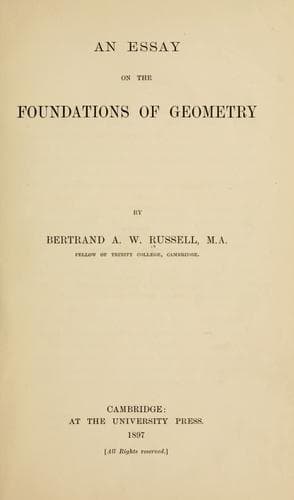
An essay on the foundations of geometryRussell, Bertrand
Philosophy
An essay on the foundations of geometry
Russell, Bertrand
Geometry -- Foundations
prove a _reductio ad absurdum_: _B_ would think, he says, that he
was describing two paths wholly the same in direction, and then he
_might_ regard both paths as circles in a plane. It may be observed
that direction, when applied to a circle as a whole, is meaningless;
indeed direction, in all Metageometry, can only mean, even when
applied to straight lines, direction towards a point. To speak of
two lines, which do not meet, as having the same direction, is a
surreptitious introduction of the axiom of parallels. Apart from
this, I cannot conceive any objection, on _B_'s part, to such a
view--one should say _must_, not _might_. The whole argumentation,
therefore, unless its obscurity has led me astray, must be pronounced
fruitless and inconclusive.
=94.= After this preliminary discussion of Sphereland, Lotze proceeds
to the question of a fourth dimension, and thence to spherical and
pseudo-spherical space. As before, he appears to know only the
more careless and popular utterances of Helmholtz and Riemann, and
to have taken no trouble to understand even the foundations of
mathematical Metageometry. By this neglect, much of what he says
is rendered wholly worthless. To begin with, he regards, as the
purpose of Helmholtz's fairy tale, the suggestion of a possible
fourth dimension, whereas the real purpose was quite the opposite--to
make intelligible a purely three-dimensional non-Euclidean space.
Helmholtz introduced Flatland only because its relation to Sphereland
is analogous to the relation of ours to spherical space[106]. But
Lotze says: The Flatlanders would find no difficulty in a third
dimension, since it would in no way contradict their own Geometry,
while the people in Sphereland, from the contradictions in their
two-dimensional system, would already have been led to it. The
latter contention I have already tried to answer; the former has an
odd sound, in view of the attempt, a few pages later, to prove _à
priori_ that all forms of intuition, in any way analogous to space,
_must_ have three dimensions. One cannot help suspecting that the
Flatlanders, with two instead of three dimensions, would make a
similar attempt. But to return to Lotze's argument: Neither analogy
can be used, he says, to prove that we ought perhaps to set up a
fourth dimension, since, for us, no contradictions or otherwise
inexplicable phenomena exist. The only people, so far as I know, who
have used this analogy, are Dr Abbot and a few Spiritualists--the
former in joke, the latter to explain certain phenomena more simply
explained, perhaps, by Maskelyne and Cooke. But although Lotze's
conclusion in this matter is sound, and one with which Helmholtz
might have agreed, his arguments, to my mind, are irrelevant and
unconvincing. There is this difference, he says, between us and the
Spherelanders: the latter were logically forced to a new dimension,
and found it possible; we are not forced to it, and find it, in our
space, impossible.
Public-domain text, read in full here on John Shaqi.
Reviews
Reviews
No reviews yet
Be the first to share your thoughts on this work.
Elsewhere in the archive
Join the Discussion
Join the discussion
Sign in to leave a comment or review.
Sign InorCreate an account