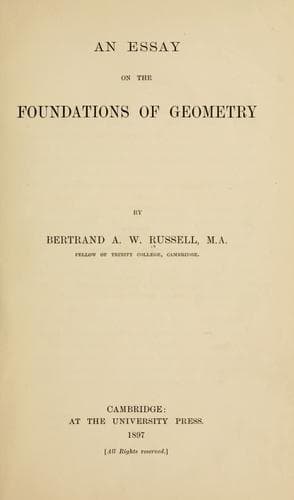
An essay on the foundations of geometryRussell, Bertrand
Philosophy
An essay on the foundations of geometry
Russell, Bertrand
Geometry -- Foundations
_Renouvier_, finally, is a pure Kantian, of the most orthodox type.
His views as to the importance, for Geometry, of the distinction
between synthetic and analytic judgments, have been discussed, in
connection with Kant, at the beginning of the present Chapter[115].
=101.= Before beginning the constructive argument of the next
Chapter, let us endeavour briefly to sum up the theories which
have been polemically advocated throughout the criticisms we have
just concluded. We agreed to accept, with Kant, necessity for any
possible experience as the test of the _à priori_, but we refused,
for the present, to discuss the connection of the _à priori_ with
the subjective, regarding the purely logical test as sufficient for
our immediate purpose. We also refused to attach importance to the
distinction of analytic and synthetic, since it seemed to apply, not
to different judgments, but only to different aspects of any judgment.
We then discussed Riemann's attempt to identify the empirical element
in Geometry with the element not deducible from ideas of magnitude,
and we decided that this identification was due to a confusion as
to the nature of magnitude. For judgments of magnitude, we said,
require always some qualitative basis, which is not quantitatively
expressible.
In criticizing Helmholtz, we decided that Mechanics logically
presupposes Geometry, though space presupposes matter; but that the
matter which space presupposes, and to which Geometry indirectly
refers, is a more abstract matter than that of Mechanics, a matter
destitute of force and of causal attributes, and possessed only
of the purely spatial attributes required for the possibility
of spatial figures. But we conceded that Geometry, when applied
to mixed mathematics or to daily life, demands more than this,
demands, in fact, some means of discovering, in the more concrete
matter of Mechanics, either a rigid body, or a body whose departure
from rigidity follows some empirically discoverable law. _Actual_
measurement, therefore, we agreed to regard as empirical.
Our conclusions, as regards the empiricism of Riemann and Helmholtz,
were reinforced by a criticism of Erdmann. We then had an opposite
task to perform, in defending Metageometry against Lotze. Here we
saw that there are two senses in which Metageometry is possible. The
first concerns our actual space, and asserts that it may have a very
small space-constant; the second concerns philosophical theories
of space, and asserts a purely logical possibility, which leaves
the decision to experience. We saw also that Lotze's mathematical
strictures arose from insufficient knowledge of the subject, and
could all be refuted by a better acquaintance with Metageometry.
Public-domain text, read in full here on John Shaqi.
Reviews
Reviews
No reviews yet
Be the first to share your thoughts on this work.
Elsewhere in the archive
Join the Discussion
Join the discussion
Sign in to leave a comment or review.
Sign InorCreate an account