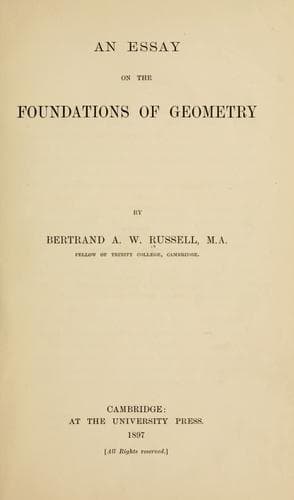
An essay on the foundations of geometryRussell, Bertrand
Philosophy
An essay on the foundations of geometry
Russell, Bertrand
Geometry -- Foundations
Finally, we discussed the question of absolute magnitude, and found
in it no logical obstacle to non-Euclidean spaces. Our conclusion,
then, in so far as we are as yet entitled to a conclusion, is
that all spaces with a space-constant are _à priori_ justifiable,
and that the decision between them must be the work of experience.
Spaces without a space-constant, on the other hand, spaces, that is,
which are not homogeneous throughout, we found logically unsound
and impossible to know, and therefore to be condemned _à priori_.
The constructive proof of this thesis will form the argument of the
following chapter.
FOOTNOTES:
[67] The Critical Philosophy of Kant, Vol. I. p. 287.
[68] For a discussion of Kant from a less purely mathematical
standpoint, see Chap. IV.
[69] Cf. Vaihinger's Commentar, II. pp. 202, 265. Also p. 336 ff.
[70] E.g. second edition, p. 39: "So werden auch alle geometrischen
Grundsätze, z. B. dass in einem Triangel zwei Seiten zusammen grösser
sind als die dritte, niemals aus allgemeinen Begriffen von Linie
und Triangel, sondern aus der Anschauung, und zwar _à priori_ mit
apodiktischer Gewissheit abgeleitet."
[71] Cf. Bradley's Logic, Bk. III. Pt. I. Chap. VI.; Bosanquet's
Logic, Bk. I. Chap. I. pp. 97-103.
[72] Philosophie de la Règle et du Compas, Année Philosophique, II.
pp. 1-66.
[73] I have stated this doctrine dogmatically, as a proof would
require a whole treatise on Logic. I accept the proofs offered by
Bradley and Bosanquet, to which the reader is referred.
[74] For a further discussion of this point, see Chaps. III. and IV.
[75] See Chap. IV. for a discussion of this argument.
[76] See Chap. IV. § 185.
[77] An Otherness of substance, rather than of attribute, is here
intended; an Otherness which may perhaps be called real as opposed to
logical diversity.
[78] This proposition will be argued at length in Chap. IV.
[79] See Psychologie als Wissenschaft, I. Section III. Chap. VII.;
II. Section I. Chap. III. and Section II. Chap. III. Compare also
Synechologie, Section I. Chaps. II. and III.
[80] On the influence of Herbart on Riemann, compare Erdmann, Die
Axiome der Geometrie, p. 30.
[81] I do not mean that measurement of colours is effected without
reference to their relations, since all measurement is essentially
comparison. But in colours, it is the elements which are compared,
while in space, it is the relations between elements.
[82] For a discussion of this point, see Chap. III. Sec. B, § 176.
Public-domain text, read in full here on John Shaqi.
Reviews
Reviews
No reviews yet
Be the first to share your thoughts on this work.
Elsewhere in the archive
Join the Discussion
Join the discussion
Sign in to leave a comment or review.
Sign InorCreate an account