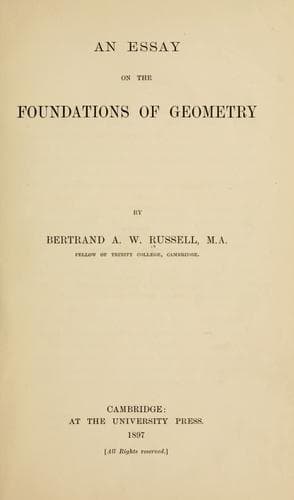
An essay on the foundations of geometryRussell, Bertrand
Philosophy
An essay on the foundations of geometry
Russell, Bertrand
Geometry -- Foundations
=104.= But unfortunately, the task of discovering the axioms of
projective Geometry is far from easy. They have, as yet, found
no Riemann or Helmholtz to formulate them philosophically. Many
geometers have constructed systems, which they intended to be, and
which, with sufficient care in interpretation, really are, free from
metrical presuppositions. But these presuppositions are so rooted
in all the very elements of Geometry, that the task of eliminating
them demands a reconstruction of the whole geometrical edifice. Thus
Euclid, for example, deals, from the start, with spatial equality--he
employs the circle, which is necessarily defined by means of
equality, and he bases all his later propositions on the congruence
of triangles as discussed in Book I.[118] Before we can use any
elementary proposition of Euclid, therefore, even if this expresses a
projective property, we have to prove that the property in question
can be deduced by projective methods. This has not, in general,
been done by projective geometers, who have too often assumed, for
example, that the quadrilateral construction--by which, as we saw in
Chap. I., they introduce projective coordinates--or anharmonic ratio,
which is _primâ facie_ metrical, could be satisfactorily established
on their principles. Both these assumptions, however, can be
justified, and we may admit, therefore, that the claims of projective
Geometry to logical independence of measurement or congruence are
valid. Let us see, then, how it proceeds.
=105.= In the first place, it is important to realize that
when coordinates are used, in projective Geometry, they are not
coordinates in the ordinary metrical sense, _i.e._ the numerical
measures of certain spatial magnitudes. On the contrary, they are a
set of numbers, arbitrarily but systematically assigned to different
points, like the numbers of houses in a street, and serving only,
from a philosophical standpoint, as convenient designations for
points which the investigation wishes to distinguish. But for the
brevity of the alphabet, in fact, they might, as in Euclid, be
replaced by letters. How they are introduced, and what they mean, has
been discussed in Chapter I. Here we have only to repeat a caution,
whose neglect has led to much misunderstanding.
Public-domain text, read in full here on John Shaqi.
Reviews
Reviews
No reviews yet
Be the first to share your thoughts on this work.
Elsewhere in the archive
Join the Discussion
Join the discussion
Sign in to leave a comment or review.
Sign InorCreate an account