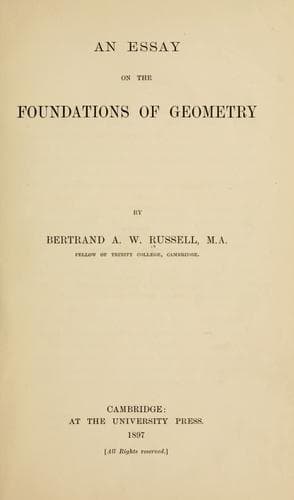
An essay on the foundations of geometry — John Shaqi
An essay on the foundations of geometryRussell, Bertrand
Philosophy
An essay on the foundations of geometry
Russell, Bertrand
Geometry -- Foundations
=4.= Now what is the connection between the subjective and the _à
priori_? It is a connection, obviously--if it exists at all--from the
outside, _i.e._ not deducible directly from the nature of either,
but provable--if it can be proved--only by a general view of the
conditions of both. The question, what knowledge is _à priori_, must,
on the above definition, depend on a logical analysis of knowledge,
by which the conditions of possible experience may be revealed; but
the question, what elements of a cognitive state are subjective, is
to be investigated by pure Psychology, which has to determine what,
in our perceptions, belongs to sensation, and what is the work of
thought or of association. Since, then, these two questions belong
to different sciences, and can be settled independently, will it not
be wise to conduct the two investigations separately? To decree that
the _à priori_ shall always be subjective, seems dangerous, when we
reflect that such a view places our results, as to the _à priori_, at
the mercy of empirical psychology. How serious this danger is, the
controversy as to Kant's pure intuition sufficiently shows.
=5.= I shall, therefore, throughout the present Essay, use the
word _à priori_ without any psychological implication. My test of
apriority will be purely logical: Would experience be impossible, if
a certain axiom or postulate were denied? Or, in a more restricted
sense, which gives apriority only within a particular science: Would
experience as to the subject-matter of that science be impossible,
without a certain axiom or postulate? My results also, therefore,
will be purely logical. If Psychology declares that some things,
which I have declared _à priori_, are not subjective, then, failing
an error of detail in my proofs, the connection of the _à priori_ and
the subjective, so far as those things are concerned, must be given
up. There will be no discussion, accordingly, throughout this Essay,
of the relation of the _à priori_ to the subjective--a relation which
cannot determine what pieces of knowledge are _à priori_, but rather
depends on that determination, and belongs, in any case, rather to
Metaphysics than to Epistemology.
=6.= As I have ventured to use the word _à priori_ in a slightly
unconventional sense, I will give a few elucidatory remarks of a
general nature.
Public-domain text, read in full here on John Shaqi.
Reviews
Reviews
No reviews yet
Be the first to share your thoughts on this work.
Join the Discussion
Join the discussion
Sign in to leave a comment or review.
Sign InorCreate an account