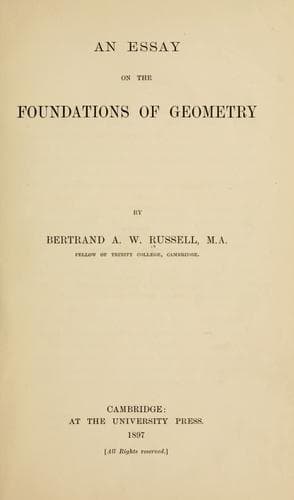
An essay on the foundations of geometryRussell, Bertrand
Philosophy
An essay on the foundations of geometry
Russell, Bertrand
Geometry -- Foundations
The _à priori_, since Kant at any rate, has generally stood for the
necessary or apodeictic element in knowledge. But modern logic has
shown that necessary propositions are always, in one aspect at least,
hypothetical. There may be, and usually is, an implication that the
connection, of which necessity is predicated, has some existence,
but still, necessity always points beyond itself to a _ground_ of
necessity, and asserts this ground rather than the actual connection.
As Bradley points out, "arsenic poisons" remains true, even if it
is poisoning no one. If, therefore, the _à priori_ in knowledge be
primarily the necessary, it must be the necessary on some hypothesis,
and the _ground_ of necessity must be included as _à priori_. But
the ground of necessity is, so far as the necessary connection in
question can show, a mere fact, a merely categorical judgment. Hence
necessity alone is an insufficient criterion of apriority.
To supplement this criterion, we must supply the hypothesis or
ground, on which alone the necessity holds, and this ground will
vary from one science to another, and even, with the progress of
knowledge, in the same science at different times. For as knowledge
becomes more developed and articulate, more and more necessary
connections are perceived, and the merely categorical truths, though
they remain the foundation of apodeictic judgments, diminish in
relative number. Nevertheless, in a fairly advanced science such as
Geometry, we can, I think, pretty completely supply the appropriate
ground, and establish, within the limits of the isolated science, the
distinction between the necessary and the merely assertorical.
=7.= There are two grounds, I think, on which necessity may be sought
within any science. These may be (very roughly) distinguished as
the ground which Kant seeks in the _Prolegomena_, and that which
he seeks in the _Pure Reason_. We may start from the existence of
our science as a fact, and analyse the reasoning employed with a
view to discovering the fundamental postulate on which its logical
possibility depends; in this case, the postulate, and all which
follows from it alone, will be _à priori_. Or we may accept the
existence of the subject-matter of our science as our basis of fact,
and deduce dogmatically whatever principles we can from the essential
nature of this subject-matter. In this latter case, however, it is
not the whole empirical nature of the subject-matter, as revealed by
the subsequent researches of our science, which forms our ground; for
if it were, the whole science would, of course, be _à priori_. Rather
it is that element, in the subject-matter, which makes _possible_
the branch of experience dealt with by the science in question[2].
The importance of this distinction will appear more clearly as we
proceed[3].
Public-domain text, read in full here on John Shaqi.
Reviews
Reviews
No reviews yet
Be the first to share your thoughts on this work.
Join the Discussion
Join the discussion
Sign in to leave a comment or review.
Sign InorCreate an account