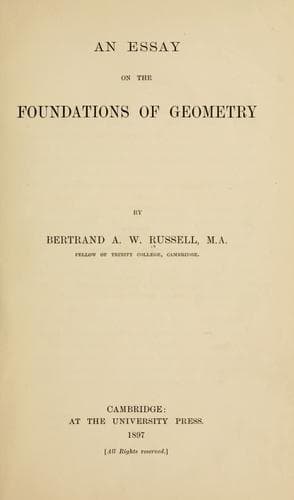
An essay on the foundations of geometryRussell, Bertrand
Philosophy
An essay on the foundations of geometry
Russell, Bertrand
Geometry -- Foundations
=121.= We can now prove, I think, that two figures, which are
projectively related, are qualitatively similar. Let us begin with
a collection of points on a straight line. So long as these are
considered without reference to other points or figures, they are
all qualitatively similar. They can be distinguished by immediate
intuition, but when we endeavour, without quantity, to distinguish
them conceptually, we find the task impossible, since the only
qualitative relation of any two of them, the straight line, is
the same for any other two. But now let us choose, at hap-hazard,
some point outside the straight line. The points of our line now
acquire new adjectives, namely their relations to the new point,
_i.e._ the straight lines joining them to this new point. But these
straight lines, reciprocally, alone define our external point,
and all straight lines are qualitatively similar. If we take some
other external point, therefore, and join it to the same points
of our original straight line, we obtain a figure in which, so
long as quantity is excluded, there is no conceptual difference
from the former figure. Immediate intuition can distinguish the
two figures, but qualitative discrimination cannot do so. Thus we
obtain a projective transformation of four lines into four other
lines, as giving a figure qualitatively indistinguishable from the
original figure. A similar argument applies to the other projective
transformations. Thus the only reason, within projective Geometry,
for not regarding projective figures as actually identical, is the
intuitive perception of difference of position. This is fundamental,
and must be accepted as a _datum_. It is presupposed in the
distinction of various points, and forms the very life of Geometry.
It is, in fact, the essence of the notion of a form of externality,
which notion forms the subject-matter of projective Geometry.
=122.= We may now sum up the results of our analysis of projective
Geometry, and state the axioms on which its reasoning is based. We
shall then have to prove that these axioms are necessary to any form
of externality, with which we shall pass, from mere analysis, to a
transcendental argument.
The axioms which have been assumed in the above analysis, and which,
it would seem, suffice to found projective Geometry, may be roughly
stated as follows:
I. We can distinguish different parts of space, but all parts are
qualitatively similar, and are distinguished only by the immediate
fact that they lie outside one another.
II. Space is continuous and infinitely divisible; the result of
infinite division, the zero of extension, is called a _point_[129].
Public-domain text, read in full here on John Shaqi.
Reviews
Reviews
No reviews yet
Be the first to share your thoughts on this work.
Elsewhere in the archive
Join the Discussion
Join the discussion
Sign in to leave a comment or review.
Sign InorCreate an account