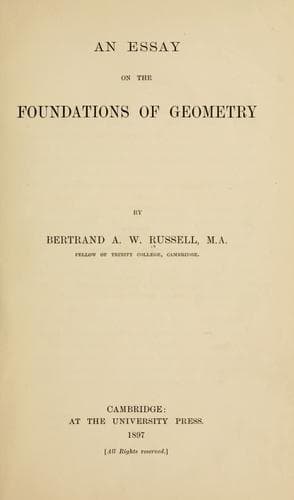
An essay on the foundations of geometryRussell, Bertrand
Philosophy
An essay on the foundations of geometry
Russell, Bertrand
Geometry -- Foundations
=124.= Now when we consider what is involved in such absolute
qualitative equivalence, we find at once, as its most obvious
prerequisite, the perfect homogeneity of space. For it is assumed
that a figure can be completely defined by its internal relations,
and that the external relations, which constitute its position,
though they suffice to distinguish it from other figures, in
no way affect its internal properties, which are regarded as
qualitatively identical with those of figures with quite different
external relations. If this were not the case, anything analogous
to projective transformation would be impossible. For such
transformation always alters the position, _i.e._ the external
relations, of a figure, and could not, therefore, if figures were
dependent on their relations to other figures or to empty space,
be studied without reference to other figures, or to the absolute
position of the original figure. We require for our principle,
in short, what may be called the mutual passivity and reciprocal
independence of two parts or figures of space.
This passivity and this independence involve the homogeneity of
space, or its equivalent, the relativity of position. For if
the internal properties of a figure are the same, whatever its
external relations may be, it follows that all parts of space are
qualitatively similar, since a change of external relation is a
change in the part of space occupied. It follows, also, that all
position is relative and extrinsic, _i.e._, that the position of a
point, or the part of space occupied by a figure, is not, and has
no effect upon, any intrinsic property of the point or figure, but
is exclusively a relation to other points or figures in space, and
remains without effect except where such relations are considered.
=125.= The homogeneity of space and the relativity of position,
therefore, are presupposed in the qualitative spatial comparison
with which projective Geometry deals. The latter, as we saw, is
also the basis of the principle of duality. But these properties,
as I shall now endeavour to prove, belong of necessity to any form
of externality, and are thus _à priori_ properties of all possible
spaces. To prove this, however, we must first define the notion of a
form of externality in general.
Let us observe, to begin with, that the distinction between
Euclidean and non-Euclidean Geometries, so important in metrical
investigations, disappears in projective Geometry proper. This
suggests that projective Geometry, though originally invented as
the science of Euclidean space, and subsequently of non-Euclidean
spaces also, deals really with a wider conception, a conception which
includes both, and neglects the attributes in which they differ. This
conception I shall speak of as a form of externality.
Public-domain text, read in full here on John Shaqi.
Reviews
Reviews
No reviews yet
Be the first to share your thoughts on this work.
Elsewhere in the archive
Join the Discussion
Join the discussion
Sign in to leave a comment or review.
Sign InorCreate an account