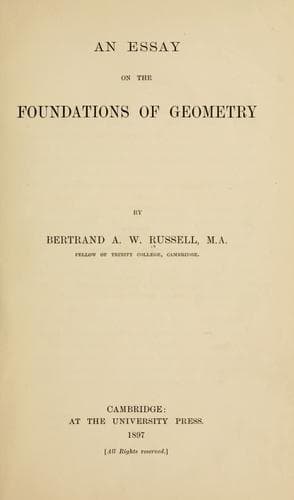
An essay on the foundations of geometryRussell, Bertrand
Philosophy
An essay on the foundations of geometry
Russell, Bertrand
Geometry -- Foundations
=126.= In Grassmann's profound philosophical introduction to his
_Ausdehnungslehre_ of 1844, he suggested that Geometry, though
improperly regarded as pure, was really a branch of applied
mathematics, since it dealt with a subject-matter not created,
like number, by the intellect, but given to it, and therefore not
wholly subject to its laws alone. But it must be possible--so he
contended--to construct a branch of pure mathematics, a science, that
is, in which our object should be wholly a creature of the intellect,
which should yet deal, as Geometry does, with extension--extension
as conceived, however, not as empirically perceived in sensation or
intuition.
From this point of view, the controversy between Kantians and
anti-Kantians becomes wholly irrelevant, since the distinction
between pure and mixed mathematics does not lie in the distinction
between the subjective and the objective, but between the purely
intellectual on the one hand, and everything else on the other.
Now Kant had contended, with great emphasis, that space was not an
intellectual construction, but a subjective intuition. Geometry,
therefore, with Grassmann's distinction, belongs to mixed mathematics
as much on Kant's view as on that of his opponents. And Grassmann's
distinction, I contend, is the more important for Epistemology,
and the one to be adopted in distinguishing the _à priori_ from
the empirical. For what is merely intuitional can change, without
upsetting the laws of thought, without making knowledge formally
impossible: but what is purely intellectual cannot change, unless the
laws of thought should change, and all our knowledge simultaneously
collapse. I shall therefore follow Grassmann's distinction in
constructing an _à priori_ and purely conceptual form of externality.
Public-domain text, read in full here on John Shaqi.
Reviews
Reviews
No reviews yet
Be the first to share your thoughts on this work.
Elsewhere in the archive
Join the Discussion
Join the discussion
Sign in to leave a comment or review.
Sign InorCreate an account