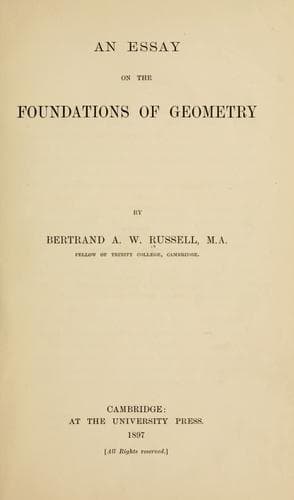
An essay on the foundations of geometryRussell, Bertrand
Philosophy
An essay on the foundations of geometry
Russell, Bertrand
Geometry -- Foundations
=138.= We have to prove that two positions must have a relation
independent of any reference to other positions. To prove this, let
us recur to what was said, in connection with dimensions, as to the
passivity and homogeneity of our form. Since positions are defined
only by relations, there must be relations, within the form, between
positions. But if there are such relations, there must be a relation
which is intrinsic to two positions. For to suppose the contrary,
is to attribute an interaction or causal connection, of some kind,
between those two positions and other positions--a supposition
which the perfect homogeneity of our form renders absurd, since all
positions are qualitatively similar, and cannot be changed without
losing their identity. We may put this argument thus: since positions
are only defined by their relations, such definition could never
begin, unless it began with a relation between only two positions.
For suppose three positions _A_, _B_, _C_ were necessary, and gave
rise to the relation _abc_ between the three. Then there would remain
no means of defining the different pairs _BC_, _CA_, _AB_, since the
only relation defining them would be one common to all three pairs.
Nothing would be gained, in this case, by reference to fresh points,
for it follows, from the homogeneity and passivity of the form, that
these fresh points could not affect the internal relations of our
triad, which relations, if they can give definiteness at all, must
give it without the aid of external reference. Two positions must,
therefore, if definition is to be possible, have some relation which
they by themselves suffice to define. Precisely the same argument
applies to three positions, or to four; the argument loses its scope
only when we have exhausted the dimensions of the form considered.
Thus, in three dimensions, five positions have no fresh relation,
not deducible from those already known, for by the definition of
dimensions, all the relations involved can be deduced from those of
the fourth point to the first three, together with those of the fifth
to the first three.
We may give the argument a more concrete, and perhaps a more
convincing shape, by considering the matter arranged in our form. If
two things are mutually external, they must since they belong to the
same world, have some relation of externality; there is, therefore,
a relation of externality between two things. But since our form is
homogeneous, the same relation of externality may subsist in other
parts of the form, _i.e._ while the two things considered alter their
relations of externality to other things. The relation of externality
between two things is, therefore, independent of other things. Hence,
when we return to the abstract language of the form, two positions
have a relation determined by those two positions alone, and
independent of other positions.
Public-domain text, read in full here on John Shaqi.
Reviews
Reviews
No reviews yet
Be the first to share your thoughts on this work.
Elsewhere in the archive
Join the Discussion
Join the discussion
Sign in to leave a comment or review.
Sign InorCreate an account