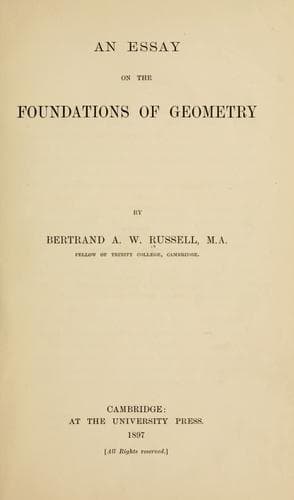
An essay on the foundations of geometryRussell, Bertrand
Philosophy
An essay on the foundations of geometry
Russell, Bertrand
Geometry -- Foundations
Precisely the same argument applies to the relations of three
positions, and in each case the relation must appear in the form as
not a mere inference from the positions it relates. For relations,
as we have seen, actually constitute a form of externality, and are
not mere inferences from terms, which are nowhere to be found in the
form[144].
To sum up: Since position is relative, two positions must have
_some_ relation to each other; and since our form of externality
is homogeneous, this relation can be kept unchanged while the two
positions change their relations to other positions. Hence their
relation is intrinsic, and independent of other positions. Since
the form is a mere complex of relations, the relation in question
must, if the form is sensuous or intuitive, be itself sensuous or
intuitive, and not a mere inference. In this case, a unique relation
must be a unique figure--in spatial terms, the straight line joining
the two points.
=139.= With this, our deduction of projective Geometry from the
_à priori_ conceptual properties of a form of externality is
completed. That such a form, when regarded as an independent thing,
is self-contradictory, has been abundantly evident throughout the
discussion. But the science of the form has been founded on the
opposite way of regarding it: we have held it throughout to be a mere
complex of relations, and have deduced its properties exclusively
from this view of it. The many difficulties, in applying such an _à
priori_ deduction to intuitive space, and in explaining, as logical
necessities, properties which appear as sensuous or intuitional data,
must be postponed to Chapter IV. For the present, I wish to point out
that projective Geometry is wholly _à priori_; that it deals with an
object whose properties are logically deduced from its definition,
not empirically discovered from data; that its definition, again, is
founded on the possibility of experiencing diversity in relation,
or multiplicity in unity; and that our whole science, therefore, is
logically implied in, and deducible from, the possibility of such
experience.
Public-domain text, read in full here on John Shaqi.
Reviews
Reviews
No reviews yet
Be the first to share your thoughts on this work.
Elsewhere in the archive
Join the Discussion
Join the discussion
Sign in to leave a comment or review.
Sign InorCreate an account