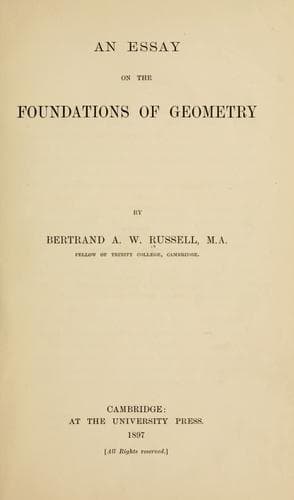
An essay on the foundations of geometryRussell, Bertrand
Philosophy
An essay on the foundations of geometry
Russell, Bertrand
Geometry -- Foundations
=140.= In metrical Geometry, on the contrary, we shall find a very
different result. Although the geometrical conditions which render
spatial measurement possible, will be found identical, except for
slight differences in the form of statement, with the _à priori_
axioms discussed above, yet the actual measurement--which deals
with actually given space, not the mere intellectual construction
we have been just discussing--gives results which can only be known
empirically and approximately, and can be deduced by no necessity
of thought. The Euclidean and non-Euclidean spaces give the various
results which are _à priori_ possible; the axioms peculiar to
Euclid--which are properly not axioms, but empirical results of
measurement--determine, within the errors of observation, which of
these _à priori_ possibilities is realized in our actual space. Thus
measurement deals throughout with an empirically given matter, not
with a creature of the intellect, and its _à priori_ elements are
only the conditions presupposed in the possibility of measurement.
What these conditions are, we shall see in the second section of this
chapter.
Section B.
THE AXIOMS OF METRICAL GEOMETRY.
=141.= We have now reviewed the axioms of projective Geometry, and
have seen that they are _à priori_ deductions from the fact that
we can experience externality, _i.e._ a coexistent multiplicity of
different but interrelated things. But projective Geometry, in spite
of its claims, is not the whole science of space, as is sufficiently
proved by the fact that it cannot discriminate between Euclidean and
non-Euclidean spaces[145]. For this purpose, spatial measurement
is required: metrical Geometry, with its quantitative tests, can
alone effect the discrimination. For all application of Geometry to
physics, also, measurement is required; the law of gravitation, for
example, requires the determination of actual distances. For many
purposes, in short, projective Geometry is wholly insufficient: thus
it is unable to distinguish between different kinds of conics, though
their distinction is of fundamental importance in many departments of
knowledge.
Public-domain text, read in full here on John Shaqi.
Reviews
Reviews
No reviews yet
Be the first to share your thoughts on this work.
Elsewhere in the archive
Join the Discussion
Join the discussion
Sign in to leave a comment or review.
Sign InorCreate an account