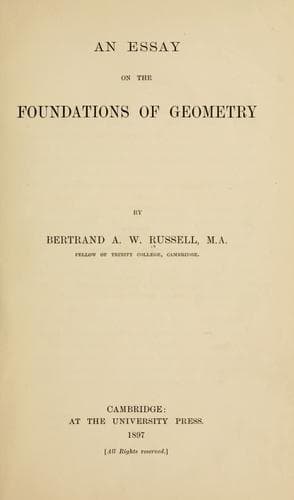
An essay on the foundations of geometryRussell, Bertrand
Philosophy
An essay on the foundations of geometry
Russell, Bertrand
Geometry -- Foundations
Metrical Geometry is, then, a necessary part of the science of
space, and a part not included in descriptive Geometry. Its _à
priori_ element, nevertheless, so far as this is spatial and not
arithmetical, is the same as the postulate of projective Geometry,
namely, the homogeneity of space, or its equivalent, the relativity
of position. We can see, in fact, that the _à priori_ element in
both is likely to be the same. For the _à priori_ in metrical
Geometry will be whatever is presupposed in the possibility of
spatial measurement, _i.e._ of quantitative spatial comparison. But
such comparison presupposes simply a known identity of quality,
the determination of which is precisely the problem of projective
Geometry. Hence the conditions for the possibility of measurement, in
so far as they are not arithmetical, will be precisely the same as
those for projective Geometry.
=142.= Metrical Geometry, therefore, though distinct from projective
Geometry, is not independent of it, but presupposes it, and arises
from its combination with the extraneous idea of _quantity_.
Nevertheless the mathematical form of the axioms, in metrical
Geometry, is slightly different from their form in projective
Geometry. The homogeneity of space is replaced by its equivalent, the
axiom of Free Mobility. The axiom of the straight line is replaced
by the axiom of distance: Two points determine a unique quantity,
distance, which is unaltered in any motion of the two points as a
single figure. This axiom, indeed, will be found to involve the axiom
of the straight line--such a quantity could not exist unless the
two points determined a unique curve--but its mathematical form is
changed. Another important change is the collapse of the principle
of duality: quantity can be applied to the straight line, because
it is divisible into similar parts, but cannot be applied to the
indivisible point. We thus obtain a reason, which was wanting in
descriptive Geometry, for preferring points, as spatial elements,
to straight lines or planes[146]. Finally, an entirely new idea is
introduced with quantity, namely, the idea of _Motion_. Not that we
study motion, or that any of our results have reference to motion,
but that they cannot, though in projective Geometry they could, be
obtained without at least an ideal motion of our figures through
space.
Public-domain text, read in full here on John Shaqi.
Reviews
Reviews
No reviews yet
Be the first to share your thoughts on this work.
Elsewhere in the archive
Join the Discussion
Join the discussion
Sign in to leave a comment or review.
Sign InorCreate an account