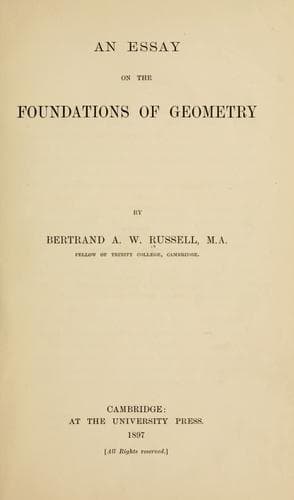
An essay on the foundations of geometryRussell, Bertrand
Philosophy
An essay on the foundations of geometry
Russell, Bertrand
Geometry -- Foundations
=162.= We have already seen, in discussing projective Geometry, that
two points must determine a unique curve, the straight line. In
metrical Geometry, the corresponding axiom is, that two points must
determine a unique spatial quantity, distance. I propose to prove,
in what follows, (1) that if distance, as a quantity completely
determined by two points, did not exist, spatial magnitude would
not be measurable; (2) that distance can only be determined by two
points, if there is an actual curve in space determined by those two
points; (3) that the existence of such a curve can be deduced from
the conception of a form of externality, and (4) that the application
of quantity to such a curve necessarily leads to a certain magnitude,
namely distance, uniquely determined by any two points which
determine the curve. The conclusion will be, if these propositions
can be successfully maintained, that the axiom of distance is _à
priori_ in the same double sense as the axiom of Free Mobility,
_i.e._ it is presupposed in the possibility of measurement, and it is
necessarily true of any possible form of externality.
=163.= (1) The possibility of spatial measurement allows us to
infer the existence of a magnitude uniquely determined by any two
points. The proof of this depends on the axiom of Free Mobility, or
its equivalent, the homogeneity of space. We have seen that these
are involved in the possibility of spatial measurement; we may
employ them, therefore, in any argument as to the conditions of this
possibility.
Now to begin with, two points must, if Geometry is to be possible,
have _some_ relation to each other, for we have seen that such
relations alone constitute position or localization. But if two
points have a relation to each other, this must be an intrinsic
relation. For it follows, from the axiom of Free Mobility, that
two points, forming a figure congruent with the given pair, can be
constructed in any part of space. If this were not possible, we have
seen that metrical Geometry could not exist. But both the figures may
be regarded as composed of two points and their relation; if the
two figures are congruent, therefore, it follows that the relation
is quantitatively the same for both figures, since congruence is the
test of spatial equality. Hence the two points have a quantitative
relation, which is such that they can traverse all space in a
combined motion without in any way altering that relation. But in
such a general motion, any external relation of the two points,
any relation involving other points or figures in space, must be
altered[170]. Hence the relation between the two points, being
unaltered, must be an intrinsic relation, a relation involving no
other point or figure in space; and this intrinsic relation we call
distance[171].
Public-domain text, read in full here on John Shaqi.
Reviews
Reviews
No reviews yet
Be the first to share your thoughts on this work.
Elsewhere in the archive
Join the Discussion
Join the discussion
Sign in to leave a comment or review.
Sign InorCreate an account