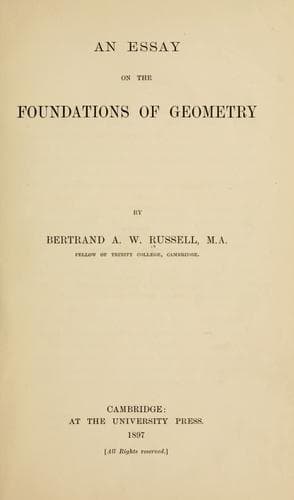
An essay on the foundations of geometryRussell, Bertrand
Philosophy
An essay on the foundations of geometry
Russell, Bertrand
Geometry -- Foundations
=164.= It might be objected, to the above argument, that it involves
a _petitio principii_. For it has been assumed that the two points
and their relation form a figure, to which other figures can be
congruent. Now if two points have no intrinsic relation, it would
seem that they cannot form such a figure. The argument, therefore,
apparently assumes what it had to prove. Why, it may be asked, should
not three points be required, before we obtain any relation, which
Free Mobility allows us to construct afresh in other parts of space?
The answer to this, as to the corresponding question in the first
section of this chapter, lies, I think, in the passivity of space,
or the mutual independence of its parts. For it follows, from this
independence, that any figure, or any assemblage of points, may
be discussed without reference to other figures or points. This
principle is the basis of infinite divisibility, of the use of
quantity in Geometry, and of all possibility of isolating particular
figures for discussion. It follows that two points cannot be
dependent, as to their relation, on any other points or figures, for
if they were so dependent, we should have to suppose some action
of such points or figures on the two points considered, which
would contradict the mutual independence of different positions.
To illustrate by an example: the relation of two given points does
not depend on the other points of the straight line on which the
given points lie. For only through their relation, _i.e._ through
the straight line which they determine, can the other points of the
straight line be known to have any peculiar connection with the given
pair.
=165.= But why, it may be asked, should there be only one such
relation between two points? Why not several? The answer to this lies
in the fact that points are wholly constituted by relations, and have
no intrinsic nature of their own[172]. A point is defined by its
relations to other points, and when once the relations necessary for
definition have been given, no fresh relations to the points used in
definition are possible, since the point defined has no qualities
from which such relations could flow. Now one relation to any one
other point is as good for definition as more would be, since however
many we had, they would all remain unaltered in a combined motion of
both points. Hence there can only be one relation determined by any
two points.
=166.= (2) We have thus established our first proposition--two points
have one and only one relation uniquely determined by those two
points. This relation we call their distance apart. It remains to
consider the conditions of the measurement of distance, _i.e._, how
far a unique value for distance involves a curve uniquely determined
by the two points.
Public-domain text, read in full here on John Shaqi.
Reviews
Reviews
No reviews yet
Be the first to share your thoughts on this work.
Elsewhere in the archive
Join the Discussion
Join the discussion
Sign in to leave a comment or review.
Sign InorCreate an account