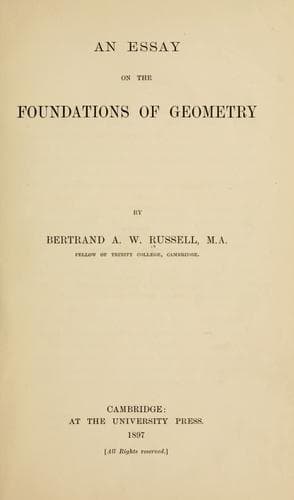
An essay on the foundations of geometryRussell, Bertrand
Philosophy
An essay on the foundations of geometry
Russell, Bertrand
Geometry -- Foundations
In the first place, some curve joining the two points is involved
in the above notion of a combined motion of the two points, or of
two other points forming a figure congruent with the first two.
For without some such curve, the two point-pairs cannot be known
as congruent, nor can we have any test by which to discover when
a point-pair is moving as a single figure[173]. Distance must be
measured, therefore, by some line which joins the two points. But
need this be a line which the two points completely determine?
=167.= We are accustomed to the definition of the straight line
as the _shortest_ distance between two points, which implies that
distance might equally well be measured by curved lines. This
implication I believe to be false, for the following reasons. When we
speak of the length of a curve, we can give a meaning to our words
only by supposing the curve divided into infinitesimal rectilinear
arcs, whose sum gives the length of an equivalent straight line;
thus unless we presuppose the straight line, we have no means of
comparing the lengths of different curves, and can therefore never
discover the applicability of our definition. It might be thought,
perhaps, that some other line, say a circle, might be used as the
basis of measurement. But in order to estimate in this way the length
of any curve other than a circle, we should have to divide the curve
into infinitesimal circular arcs. Now two successive points do not
determine a circle, so that an arc of two points would have an
indeterminate length. It is true that, if we exclude infinitesimal
radii for the measuring circles, the lengths of the infinitesimal
arcs would be determinate, even if the circles varied, but that is
only because all the small circular arcs through two consecutive
points coincide with the straight line through those two points.
Thus, even with the help of the arbitrary restriction to a finite
radius, all that happens is that we are brought back to the straight
line. If, to mend matters, we take three consecutive points of our
curve, and reckon distance by the arc of the circle of curvature,
the notion of distance loses its fundamental property of being a
relation between _two_ points. For two consecutive points of the
arc could not then be said to have any corresponding distance
apart--three points would be necessary before the notion of distance
became applicable. Thus the circle is not a possible basis for
measurement, and similar objections apply, of course, with increased
force, to any other curve. All this argument is designed to show,
in detail, the logical impossibility of measuring distance by any
curve not completely defined by the two points whose distance apart
is required. If in the above we had taken distance as measured
by circles of _given radius_, we should have introduced into its
definition a relation to other points besides the two whose distance
was to be measured, which we saw to be a logical fallacy. Moreover,
Public-domain text, read in full here on John Shaqi.
Reviews
Reviews
No reviews yet
Be the first to share your thoughts on this work.
Elsewhere in the archive
Join the Discussion
Join the discussion
Sign in to leave a comment or review.
Sign InorCreate an account