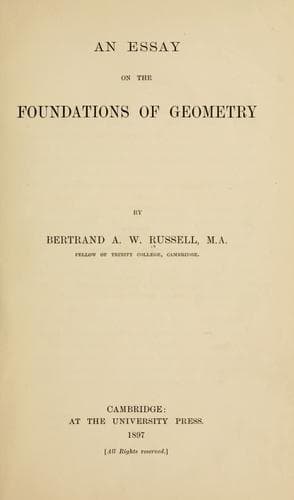
An essay on the foundations of geometryRussell, Bertrand
Philosophy
An essay on the foundations of geometry
Russell, Bertrand
Geometry -- Foundations
=176.= In connection with the straight line, it will be convenient
to discuss the conditions of a metrical coordinate system. The
projective coordinate system, as we have seen, aims only at a
convenient nomenclature for different points, and can be set up
without introducing the notion of spatial quantity. But a metrical
coordinate system does much more than this. It defines every point
quantitatively, by its quantitative spatial relations to a certain
coordinate figure. Only when the system of coordinates is thus
metrical, _i.e._, when every coordinate represents some spatial
magnitude, which is itself a relation of the point defined to some
other point or figure--can operations with coordinates lead to a
metrical result. When, as in projective Geometry, the coordinates
are not spatial magnitudes, no amount of transformation can give a
metrical result. I wish to prove, here, that a metrical coordinate
system necessarily involves the straight line, and cannot, without a
logical fallacy, be set up on any other basis. The projective system
of coordinates, as we saw, is entirely based on the straight line;
but the metrical system is more important, since its quantities
embody actual information as to spatial magnitudes, which, in
projective Geometry, is not the case.
In the first place, a point's metrical coordinates constitute a
complete quantitative definition of it; now a point can only be
defined, as we have seen, by its relations to other points, and
these relations can only be defined by means of the straight line.
Consequently, any metrical system of coordinates must involve the
straight line, as the basis of its definitions of points.
This _à priori_ argument, however, though I believe it to be quite
sound, is not likely to carry conviction to any one persuaded of the
opposite. Let us, therefore, examine metrical coordinate systems in
detail, and show, in each case, their dependence on the straight line.
Public-domain text, read in full here on John Shaqi.
Reviews
Reviews
No reviews yet
Be the first to share your thoughts on this work.
Elsewhere in the archive
Join the Discussion
Join the discussion
Sign in to leave a comment or review.
Sign InorCreate an account