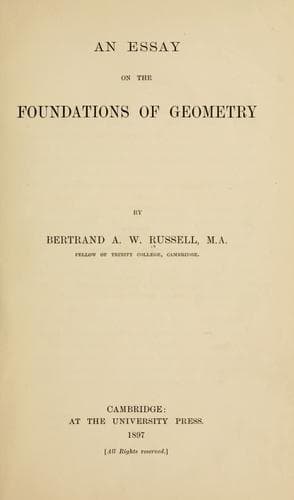
An essay on the foundations of geometryRussell, Bertrand
Philosophy
An essay on the foundations of geometry
Russell, Bertrand
Geometry -- Foundations
We have already seen that the notion of distance is impossible
without the straight line. We cannot, therefore, define our
coordinates in any of the ordinary ways, as the distances from three
planes, lines, points, spheres, or what not. Polar coordinates
are impossible, since,--waiving the straightness of the radius
vector--the length of the radius vector becomes unmeaning. Triangular
coordinates involve not only angles, which must in the limit be
rectilinear, but straight lines, or at any rate some well-defined
curves. Now curves can only be metrically defined in two ways:
_Either_ by relation to the straight line, as, _e.g._, by the
curvature at any point, _or_ by purely analytical equations, which
presuppose an intelligible system of metrical coordinates. What
methods remain for assigning these arbitrary values to different
points? Nay, how are we to get any estimate of the difference--to
avoid the more special notion of distance--between two points?
The very notion of a point has become illusory. When we have a
coordinate system, we may define a point by its three coordinates;
in the absence of such a system, we may define the notion of point
_in general_ as the intersection of three surfaces or of two curves.
Here we take surfaces and curves as notions which intuition makes
plain, but if we wish them to give us a precise numerical definition
of _particular_ points, we must specify the kind of surface or
curve to be used. Now this, as we have seen, is only possible when
we presuppose either the straight line, or a coordinate system. It
follows that every coordinate system presupposes the straight line,
and is logically impossible without it.
=177.= The above three axioms, we have seen, are _à priori_ necessary
to metrical Geometry. No others can be necessary, since metrical
systems, logically as unassailable as Euclid's, and dealing with
spaces equally homogeneous and equally relational, have been
constructed by the metageometers, without the help of any other
axioms. The remaining axioms of Euclidean Geometry--the axiom of
parallels, the axiom that the number of dimensions is three, and
Euclid's form of the axiom of the straight line (two straight lines
cannot enclose a space)--are not essential to the possibility of
metrical Geometry, _i.e._, are not deducible from the fact that
a science of spatial magnitudes is possible. They are rather
to be regarded as empirical laws, obtained, like the empirical
laws of other sciences, by actual investigation of the given
subject-matter--in this instance, experienced space.
=178.= In summing up the distinctive argument of this Section,
we may give it a more general form, and discuss the conditions
of measurement in any continuous manifold, _i.e._, the qualities
necessary to the manifold, in order that quantities in it may be
determinable, not only as to the more or less, but as to the precise
_how much_.
Public-domain text, read in full here on John Shaqi.
Reviews
Reviews
No reviews yet
Be the first to share your thoughts on this work.
Elsewhere in the archive
Join the Discussion
Join the discussion
Sign in to leave a comment or review.
Sign InorCreate an account