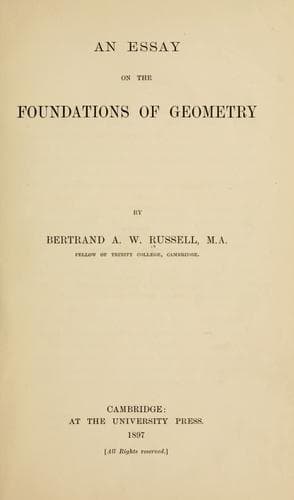
An essay on the foundations of geometryRussell, Bertrand
Philosophy
An essay on the foundations of geometry
Russell, Bertrand
Geometry -- Foundations
Measurement, we may say, is the application of number to continua,
or, if we prefer it, the transformation of mere quantity into number
of units. Using _quantity_ to denote the vague more or less, and
_magnitude_ to denote the precise number of units, the problem of
measurement may be defined as the transformation of quantity into
magnitude.
Now a number, to begin with, is a whole consisting of smaller units,
all of these units being qualitatively alike. In order, therefore,
that a continuous quantity may be expressible as a number, it must,
on the one hand, be itself a whole, and must, on the other hand,
be divisible into qualitatively similar parts. In the aspect of a
whole, the quantity is _intensive_; in the aspect of an aggregate of
parts, it is _extensive_. A purely intensive quantity, therefore,
is not numerable--a purely extensive quantity, if any such could
be imagined, would not be a single quantity at all, since it would
have to consist of wholly unsynthesized particulars. A measurable
quantity, therefore, is a whole divisible into similar parts. But
a continuous quantity, if divisible at all, must be _infinitely_
divisible. For otherwise the points at which it could be divided
would form natural barriers, and so destroy its continuity. But
further, it is not sufficient that there should be a possibility
of division into mutually external parts; while the parts, to be
perceptible as parts, must be mutually external, they must also, to
be knowable as _equal_ parts, be capable of overcoming their mutual
externality. For this, as we have seen, we require superposition,
which involves Free Mobility and homogeneity--the absence of Free
Mobility in time, where all other requisites of measurement are
fulfilled, renders direct measurement of time impossible. Hence
infinite divisibility, free mobility, and homogeneity are necessary
for the possibility of measurement in _any_ continuous manifold, and
these, as we have seen, are equivalent to our three axioms. These
axioms are necessary, therefore, not only for spatial measurement,
but for all measurement. The only manifold given in experience, in
which these conditions are satisfied, is space. All other exact
measurement--as could be proved, I believe, for every separate
case--is effected, as we saw in the case of time, by reduction to
a spatial correlative. This explains the paramount importance, to
exact science, of the mechanical view of nature, which reduces
all phenomena to motions in time and space. For number is, of
all conceptions, the easiest to operate with, and science seeks
everywhere for an opportunity to apply it, but finds this opportunity
only by means of spatial equivalents to phenomena[177].
Public-domain text, read in full here on John Shaqi.
Reviews
Reviews
No reviews yet
Be the first to share your thoughts on this work.
Elsewhere in the archive
Join the Discussion
Join the discussion
Sign in to leave a comment or review.
Sign InorCreate an account