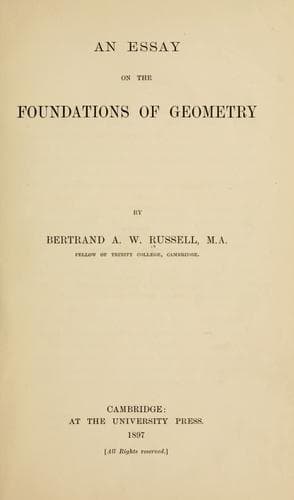
An essay on the foundations of geometryRussell, Bertrand
Philosophy
An essay on the foundations of geometry
Russell, Bertrand
Geometry -- Foundations
=179.= We have now seen in what the _à priori_ element of Geometry
consists. This _à priori_ element may be defined as the axioms common
to Euclidean and non-Euclidean spaces, as the axioms deducible from
the conception of a form of externality, or--in metrical Geometry--as
the axioms required for the possibility of measurement. It remains
to discuss, in a final chapter, some questions of a more general
philosophic nature, in which we shall have to desert the firm ground
of mathematics and enter on speculations which I put forward very
tentatively, and with little faith in their ultimate validity. The
chief questions for this final chapter will be two: (1) How is such
_à priori_ and purely logical necessity possible, as applied to an
actually given subject-matter like space? (2) How can we remove the
contradictions which have haunted us in this chapter, arising out of
the relativity, infinite divisibility, and unbounded extension of
space? These two questions are forced upon us by the present chapter,
but as they open some of the fundamental problems of philosophy, it
would be rash to expect a conclusive or wholly satisfactory answer. A
few hints and suggestions may be hoped for, but a complete solution
could only be obtained from a complete philosophy, of which the
prospects are far too slender to encourage a confident frame of mind.
FOOTNOTES:
[116] See infra, Axiom of Distance, in Sec. B. of this Chapter.
[117] Thus on a cylinder, two geodesics, _e.g._ a generator and
a helix, may have any number of intersections--a very important
difference from the plane.
[118] Cf. Cremona, Projective Geometry (Clarendon Press, 2nd ed.
1893) p. 50: "Most of the propositions in Euclid's Elements are
metrical, and it is not easy to find among them an example of a
purely descriptive theorem."
[119] Op. cit. p. 226.
[120] Some ground for this choice will appear when we come to
metrical Geometry.
[121] The straight line _σa_ denotes the straight line common to the
planes _σ_ and _a_, the point _σa_ denotes the point common to the
plane _σ_ and the straight line _a_, and similarly for the rest of the
notation.
[122] Cremona (op. cit. Chap. IX. p. 50) defines anharmonic ratio as
a metrical property which is unaltered by projection. This, however,
destroys the logical independence of projective Geometry, which can
only be maintained by a purely descriptive definition.
[123] There is no corresponding property of _three_ points on a line,
because they can be projectively transformed into any other three
points on the same line. See § 120.
[124] Due to v. Staudt's "Geometrie der Lage."
[125] See Cremona, op. cit. Chapter VIII.
[126] The corresponding definitions, for the two-dimensional manifold
of lines through a point, follow by the principle of duality.
Public-domain text, read in full here on John Shaqi.
Reviews
Reviews
No reviews yet
Be the first to share your thoughts on this work.
Elsewhere in the archive
Join the Discussion
Join the discussion
Sign in to leave a comment or review.
Sign InorCreate an account