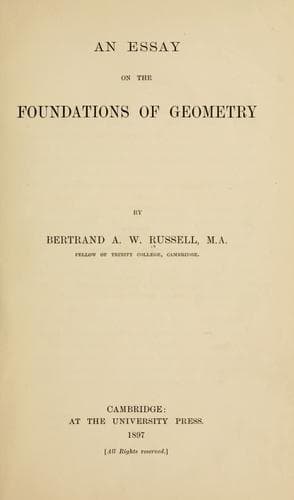
An essay on the foundations of geometryRussell, Bertrand
Philosophy
An essay on the foundations of geometry
Russell, Bertrand
Geometry -- Foundations
[127] It is important to observe that this definition of the Point
introduces metrical ideas. Without metrical ideas, we saw, nothing
appears to give the Point precedence of the straight line, or indeed
to distinguish it conceptually from the straight line. A reference
to quantity is therefore inevitable in defining the Point, if the
definition is to be geometrical. A non-metrical definition would have
to be also non-geometrical. See Chap. IV. §§ 196-199.
[128] §§ 163-175.
[129] On this axiom, however, compare § 131.
[130] For the proof of this proposition, see Chap. III. Sec. B, Axiom
of Dimensions.
[131] The straight line and plane, in all discussions of general
Geometry, are not necessarily Euclidean. They are simply figures
determined, in general, by two and by three points respectively;
whether they conform to the axiom of parallels and to Euclid's form
of the axiom of the straight line, is not to be considered in the
general definition.
[132] That projective Geometry must have existential import, I shall
attempt to prove in Chapter IV.
[133] Logic, Book I. Chapter II.
[134] Cf. Bradley's Logic, p. 63. It will be seen that the sense in
which I have spoken of space as a principle of differentiation is not
the sense of a "principle of individuation" which Bradley objects to.
[135] Chap. IV. §§ 186-191.
[136] Chap. IV. § 201 ff.
[137] It is important to observe, however, that this way of regarding
spatial relations is metrical; from the projective standpoint, the
relation between two points is the whole unbounded straight line on
which they lie, and need not be regarded as divisible into parts or
as built up of points.
[138] §§ 207, 208. Cf. Hegel, Naturphilosophie, § 254.
[139] See Chap. IV. §§ 196-199.
[140] See a forthcoming article on "The relations of number and
quantity" by the present writer in _Mind_, July, 1897.
[141] Logic, Vol. II. Chap. VII. p. 211.
[142] Real, as opposed to logical, diversity is throughout intended.
Diverse aspects may coexist in a thing at one time and place, but two
diverse real things cannot so coexist.
[143] On the insufficiency of time alone, see Chapter IV. § 191.
[144] Geometrically, the axiom of the plane is, not that three
points determine a figure at all, which follows from the axiom of
the straight line, but that the straight line joining two casual
points of the plane lies wholly in the plane. This axiom requires a
projective method of constructing the plane, _i.e._ of finding all
the triads of points which determine the same projective figure as
the given triad. The required construction will be obtained if we
can find any projective figure determined by three points, and any
projective method of reaching other points which determine the same
figure.
[Illustration]
Public-domain text, read in full here on John Shaqi.
Reviews
Reviews
No reviews yet
Be the first to share your thoughts on this work.
Elsewhere in the archive
Join the Discussion
Join the discussion
Sign in to leave a comment or review.
Sign InorCreate an account