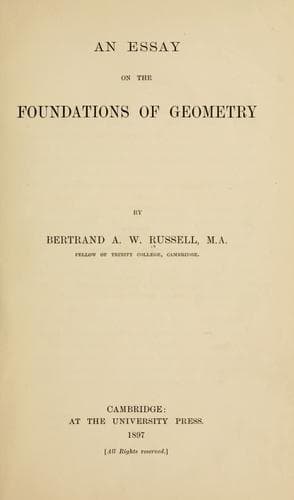
An essay on the foundations of geometryRussell, Bertrand
Philosophy
An essay on the foundations of geometry
Russell, Bertrand
Geometry -- Foundations
Let _O_, _P_, _Q_ be the three points whose projective relation
is required. Then we have given us the three straight lines _PQ_,
_QO_, _OP_. Metrically, the relation between these points is made
up of the area, and the magnitude of the sides and angles, of the
triangle _OPQ_, just as the relation between two points is distance.
But projectively, the figure is unchanged when _P_ and _Q_ travel
along _OP_ and _OQ_, or when _OP_ and _OQ_ turn about _O_ in such a
way as still to meet _PQ_. This is a result of the general principle
of projective equivalence enunciated above (§§ 108, 109). Hence the
projective relation between _O_, _P_, _Q_ is the same as that between
_O_, _p_, _q_ or _O_, _P′_, _Q′_; that is, _p_, _q_ and _P′_, _Q′_
lie in the plane _OPQ_. In this way, any number of points on the
plane may be obtained, and by repeating the construction with fresh
triads, every point of the plane can be reached. We have to prove
that, when the plane is so constructed, the straight line joining any
two points of the plane lies wholly in the plane.
It is evident, from the manner of construction, that any point of
_PQ_, _OP_, _OQ_, _OP′_ or _OQ′_ lies in the plane. If we can prove
that any point of _pq_ lies in the plane, we shall have proved all
that is required, since _pq_ may be transformed, by successive
repetitions of the same construction, into any straight line joining
two points of the plane. But we have seen that the same plane is
determined by _O_, _p_, _q_ and by _O_, _P_, _Q_. The straight lines
_PQ_, _pq_ have, therefore, the same relation to the plane. But _PQ_
lies wholly in the plane; therefore _pq_ also lies wholly in the
plane. Hence our axiom is proved.
[145] A detailed proof has been given above, Chap. I. 3rd period. It
is to be observed that any reference to infinitely distant elements
involves metrical ideas.
[146] Cf. Section A, §§ 115-117.
[147] Contrast Erdmann, op. cit. p. 138.
[148] Cf. Erdmann, op. cit. p. 164.
[149] Strictly speaking, this method is only applicable where the two
magnitudes are commensurable. But if we take infinite divisibility
rigidly, the units can theoretically be taken so small as to obtain
any required degree of approximation. The difficulty is the universal
one of applying to continua the essentially discrete conception of
number.
[150] Cf. Erdmann, op. cit. p. 50.
[151] Also called the axiom of congruence. I have taken congruence to
be the _definition_ of spatial equality by superposition, and shall
therefore generally speak of the _axiom_ as Free Mobility.
[152] For the sense in which these figures are to be regarded as
material, see criticism of Helmholtz, Chapter II. §§ 69 ff.
[153] Op. cit. p. 60.
[154] The view of Helmholtz and Erdmann, that mechanical experience
suffices here, though geometrical experience fails us, has been
discussed above, Chapter II. §§ 73, 82.
[155] Chapter II. § 81.
[156] Chapter II. § 72.
Public-domain text, read in full here on John Shaqi.
Reviews
Reviews
No reviews yet
Be the first to share your thoughts on this work.
Elsewhere in the archive
Join the Discussion
Join the discussion
Sign in to leave a comment or review.
Sign InorCreate an account