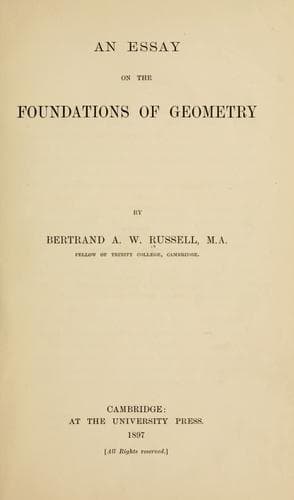
An essay on the foundations of geometryRussell, Bertrand
Philosophy
An essay on the foundations of geometry
Russell, Bertrand
Geometry -- Foundations
[157] Contrast Delbœuf, L'ancienne et les nouvelles géométries, II.
Rev. Phil. 1894, Vol. xxxvii. p. 354.
[158] Prolegomena, § 13. See Vaihinger's Commentar, II. pp. 518-532
esp. pp. 521-2. The above was Kant's whole purpose in 1768, but only
part of his purpose in the Prolegomena, where the intuitive nature of
space was also to be proved.
[159] On the subject of time measurement, cf. Bosanquet's Logic, Vol.
i. pp. 178-183. Since time, in the above account, is measured by
motion, its measurement presupposes that of spatial magnitudes.
[160] Cf. Stumpf. Ursprung der Raumvorstellung, p. 68.
[161] As is Helmholtz's other axiom, that the possibility of
superposition is independent of the course pursued in bringing it
about.
[162] Cf. §§ 129, 130.
[163] This deduction is practically the same as that in Sec. A, but
I have stated it here with more special reference to space and to
metrical Geometry.
[164] The question: "Relations to what?" is a question involving
many difficulties. It will be touched on later in this chapter, and
answered, as far as possible, in the fourth chapter. For the present,
in spite of the glaring circle involved, I shall take the relations
as relations to other positions.
[165] Wiss. Abh. Vol. II. p. 614.
[166] Cp. Grassmann, Ausdehnungslehre von 1844, 2nd ed. p. XXIII.
[167] Delbœuf, it is true, speaks of Geometries with _m_/_n_
dimensions, but gives no reference (Rev. Phil. T. xxxvi. p. 450).
[168] In criticizing Erdmann, it will be remembered, we saw that Free
Mobility is a necessary property of his extents, though he does not
regard it as such.
[169] Cf. Riemann, Hypothesen welche der Geometrie zu Grunde liegen,
Gesammelte Werke, p. 266; also Erdmann, op. cit. p. 154.
[170] This is subject, in spherical space, to the modification
pointed out below, in dealing with the exception to the axiom of the
straight line. See §§ 168-171.
[171] In speaking of distance at once as a quantity and as an
intrinsic relation, I am anxious to guard against an apparent
inconsistency. I have spoken of the judgment of quantity, throughout,
as one of comparison; how, then, can a quantity be intrinsic? The
reply is that, although measurement and the judgment of quantity
express the result of comparison, yet the terms compared must exist
before the comparison; in this case, the terms compared in measuring
distances, _i.e._ in comparing them _inter se_, are intrinsic
relations between points. Thus, although the _measurement_ of
distance involves a reference to other distances, and its expression
as a magnitude requires such a reference, yet its existence does not
depend on any external reference, but exclusively on the two points
whose distance it is.
[172] See the end of the argument on Free Mobility, § 155 ff.
Public-domain text, read in full here on John Shaqi.
Reviews
Reviews
No reviews yet
Be the first to share your thoughts on this work.
Elsewhere in the archive
Join the Discussion
Join the discussion
Sign in to leave a comment or review.
Sign InorCreate an account