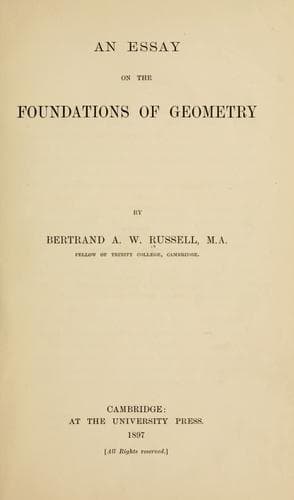
An essay on the foundations of geometryRussell, Bertrand
Philosophy
An essay on the foundations of geometry
Russell, Bertrand
Geometry -- Foundations
[173] In Frischauf's "Absolute Geometrie nach Johann Bolyai," Anhang,
there is a series of definitions, starting from the sphere, as the
locus of congruent point-pairs when one point of the pair is fixed,
and hence obtaining the circle and the straight line. From the above
it follows, that the sphere so defined already involves a curve
between the points of the point-pair, by which various point-pairs
can be known as congruent; and it will appear, as we proceed, that
this curve must be a straight line. Frischauf's definition by means
of the sphere involves, therefore, a vicious circle, since the sphere
presupposes the straight line, as the test of congruent point-pairs.
[174] Nor in any argument which, like those of projective Geometry,
avoids the notion of magnitude or distance altogether. It follows
that the propositions of projective Geometry apply, without reserve,
to spherical space, since the exception to the axiom of the straight
line arises only on metrical ground.
[175] Psychology, Vol. II. pp. 149-150.
[176] This step in the argument has been put very briefly, since it
is a mere repetition of the corresponding argument in Section A, and
is inserted here only for the sake of logical completeness. See § 137
ff.
[177] Cf. Hannequin, Essai critique sur l'hypothèse des atomes,
Paris, 1895, passim.
CHAPTER IV.
PHILOSOPHICAL CONSEQUENCES.
=180.= In the present chapter, we have to discuss two questions
which, though scarcely geometrical, are of fundamental importance
to the theory of Geometry propounded above. The first of these
questions is this: What relation can a purely logical and deductive
proof, like that from the nature of a form of externality, bear to an
experienced subject-matter such as space? You have merely framed a
general conception, I may be told, containing space as a particular
species, and you have then shown, what should have been obvious from
the beginning, that this general conception contained some of the
attributes of space. But what ground does this give for regarding
these attributes as _à priori_? The conception Mammal has some of the
attributes of a horse; but are these attributes therefore _à priori_
adjectives of the horse? The answer to this obvious objection is so
difficult, and involves so much general philosophy, that I have kept
it for a final chapter, in order not to interrupt the argument on
specially geometrical topics.
Public-domain text, read in full here on John Shaqi.
Reviews
Reviews
No reviews yet
Be the first to share your thoughts on this work.
Elsewhere in the archive
Join the Discussion
Join the discussion
Sign in to leave a comment or review.
Sign InorCreate an account