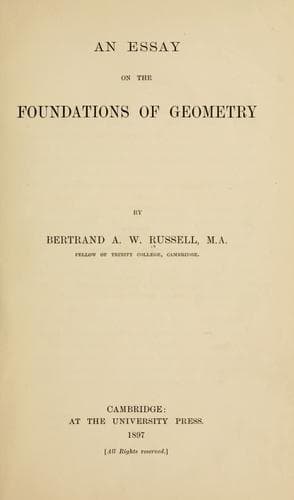
An essay on the foundations of geometryRussell, Bertrand
Philosophy
An essay on the foundations of geometry
Russell, Bertrand
Geometry -- Foundations
=181.= I have already indicated, in general terms, the ground for
regarding as _à priori_ the properties of any form of externality.
This ground is transcendental, _i.e._ it is to be found in the
conditions required for the possibility of experience. The form of
externality, like Riemann's manifolds, is a general class-conception,
including time as well as Euclidean and non-Euclidean spaces. It
is not motived, however, like the manifolds, by a _quantitative_
resemblance to space, but by the fact that it fulfils, if it has
more than one dimension, all those functions which, in our actual
world, are fulfilled by space. But a form of externality, in order
to accomplish this, must be, not a mere conception, but an actually
experienced intuition. Hence the conception of such a form is the
general _conception_, containing under it every logically possible
_intuition_ which can fulfil the function actually fulfilled by
space. And this function is, to render possible experience of
diverse but interrelated things. Some form in sense-perception,
then, whose conception is included under our form of externality,
is _à priori_ necessary to experience of diversity in relation, and
without experience of this, we should, as modern logic shows, have no
experience at all. This still leaves untouched the relation of the
_à priori_ to the subjective: the form of externality is necessary
to experience, but is not, _on that account_, to be declared purely
subjective. Of course, necessity for experience can only arise from
the nature of the mind which experiences; but it does not follow that
the necessary conditions could be fulfilled, unless the objective
world had certain properties. The _ground_ of necessity, we may
safely say, arises from the mind; but it by no means follows that
the _truth_ of what is necessary depends only on the constitution of
the mind. Where this is not the case, our conclusion, when a piece
of knowledge has been declared _à priori_, can only be: Owing to the
constitution of the _mind_, experience will be impossible unless the
_world_ accepts certain adjectives.
Such, in outline, will be the argument of the first half of this
chapter, and such will be the justification for regarding as _à
priori_ those axioms of Geometry, which were deduced above from the
conception of a form of externality. For these axioms, and these
only, are necessarily true of any world in which experience is
possible.
=182[178].= The view suggested has, obviously, much in common with
that of the Transcendental Aesthetic. Indeed the whole of it, I
believe, can be obtained by a certain limitation and interpretation
of Kant's classic arguments. But as it differs, in many important
points, from the conclusions aimed at by Kant, and as the agreement
may easily seem greater than it is, I will begin by a brief
comparison, and endeavour, by reference to authoritative criticisms,
to establish the legitimacy of my divergence from him.
Public-domain text, read in full here on John Shaqi.
Reviews
Reviews
No reviews yet
Be the first to share your thoughts on this work.
Elsewhere in the archive
Join the Discussion
Join the discussion
Sign in to leave a comment or review.
Sign InorCreate an account