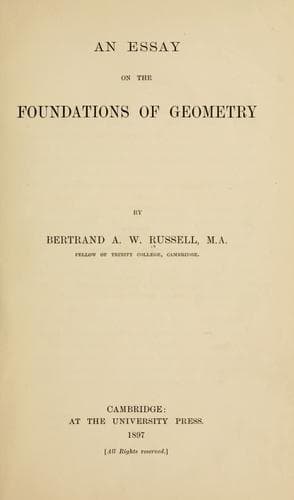
An essay on the foundations of geometryRussell, Bertrand
Philosophy
An essay on the foundations of geometry
Russell, Bertrand
Geometry -- Foundations
In the third period, which begins with Cayley, the philosophical
motive, which had moved the first pioneers, is less apparent, and
is replaced by a more technical and mathematical spirit. This
period is chiefly distinguished from the second, in a mathematical
point of view, by its method, which is projective instead of
metrical. The leading mathematical conception here is the Absolute
(_Grundgebild_), a figure by relation to which all metrical
properties become projective. Cayley's work, which was very brief,
and attracted little attention, has been perfected and elaborated by
F. Klein, and through him has found general acceptance. Klein has
added to the two kinds of non-Euclidean Geometry already known, a
third, which he calls elliptic; this third kind closely resembles
Helmholtz's spherical Geometry, but is distinguished by the important
difference that, in it, two straight lines meet in only one point[7].
The distinctive mark of the spaces represented by both is that,
like the surface of a sphere, they are finite but unbounded. The
reduction of metrical to projective properties, as will be proved
hereafter, has only a technical importance; at the same time,
projective Geometry is able to deal directly with those purely
descriptive or qualitative properties of space which are common to
Euclid and Metageometry alike. The third period has, therefore, great
philosophical importance, while its method has, mathematically, much
greater beauty and unity than that of the second; it is able to
treat all kinds of space at once, so that every symbolic proposition
is, according to the meaning given to the symbols, a proposition
in whichever Geometry we choose. This has the advantage of proving
that further research cannot lead to contradictions in non-Euclidean
systems, unless it at the same moment reveals contradictions in
Euclid. These systems, therefore, are logically as sound as that of
Euclid himself.
After this brief sketch of the characteristics of the three periods,
I will proceed to a more detailed account. It will be my aim to
avoid, as far as possible, all technical mathematics, and bring
into relief only those fundamental points in the mathematical
development, which seem of logical or philosophical importance.
First Period.
Public-domain text, read in full here on John Shaqi.
Reviews
Reviews
No reviews yet
Be the first to share your thoughts on this work.
Join the Discussion
Join the discussion
Sign in to leave a comment or review.
Sign InorCreate an account