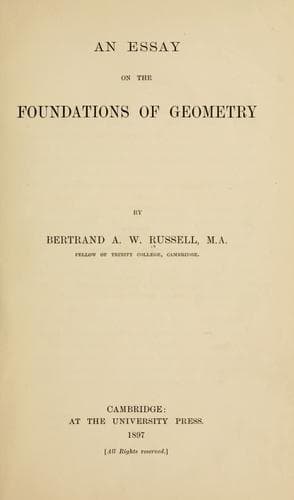
An essay on the foundations of geometryRussell, Bertrand
Philosophy
An essay on the foundations of geometry
Russell, Bertrand
Geometry -- Foundations
=197.= Thus Geometry is forced, since it wishes to regard space
as independent, to hypostatize its abstractions, and therefore to
invent a self-contradictory notion as the spatial element. A similar
absurdity appears, even more obviously, in the notion of a whole of
space. The antinomy may, therefore, be stated thus: Space, as we have
seen throughout, must, if knowledge of it is to be possible, be mere
relativity; but it must also, if _independent_ knowledge of it, such
as Geometry seeks, is to be possible, be something more than mere
relativity, since it is divisible and has parts. But we saw, in Chap.
III., Section A (§ 133) that knowledge of a form of externality must
be logically independent of the particular matter filling the form.
How then are we to extricate ourselves from this dilemma?
The only way, I think, is, not to make Geometry dependent on
Physics, which we have seen to be erroneous[192], but to give every
geometrical proposition a certain reference to matter in general. And
at this point an important distinction must be made. We have hitherto
spoken of space as relational, and of spatial figures as relations.
But space, it would seem, is rather relativity than relations--itself
not a relation, it gives the bare possibility of relations between
diverse things[193]. As applied to a spatial figure, which can only
arise by a differentiation of space, and hence by the introduction
of some differentiating matter, the word relation is, perhaps, less
misleading than any other; as applied to empty undifferentiated
space, it seems by no means an accurate description.
But a bare possibility cannot exist, or be given in sense-perception!
What becomes, then, of the arguments of the first part of this
chapter? I reply, it is not empty space, but spatial figures, which
sense-perception reveals, and spatial figures, as we have just seen,
involve a differentiation of space, and therefore a reference to the
matter which is in space. It is spatial figures, also, and not empty
space, with which Geometry has to deal. The antinomy discussed above
arises then--so it would seem--from the attempt to deal with empty
space, rather than with spatial figures and the matter to which they
necessarily refer.
Public-domain text, read in full here on John Shaqi.
Reviews
Reviews
No reviews yet
Be the first to share your thoughts on this work.
Elsewhere in the archive
Join the Discussion
Join the discussion
Sign in to leave a comment or review.
Sign InorCreate an account